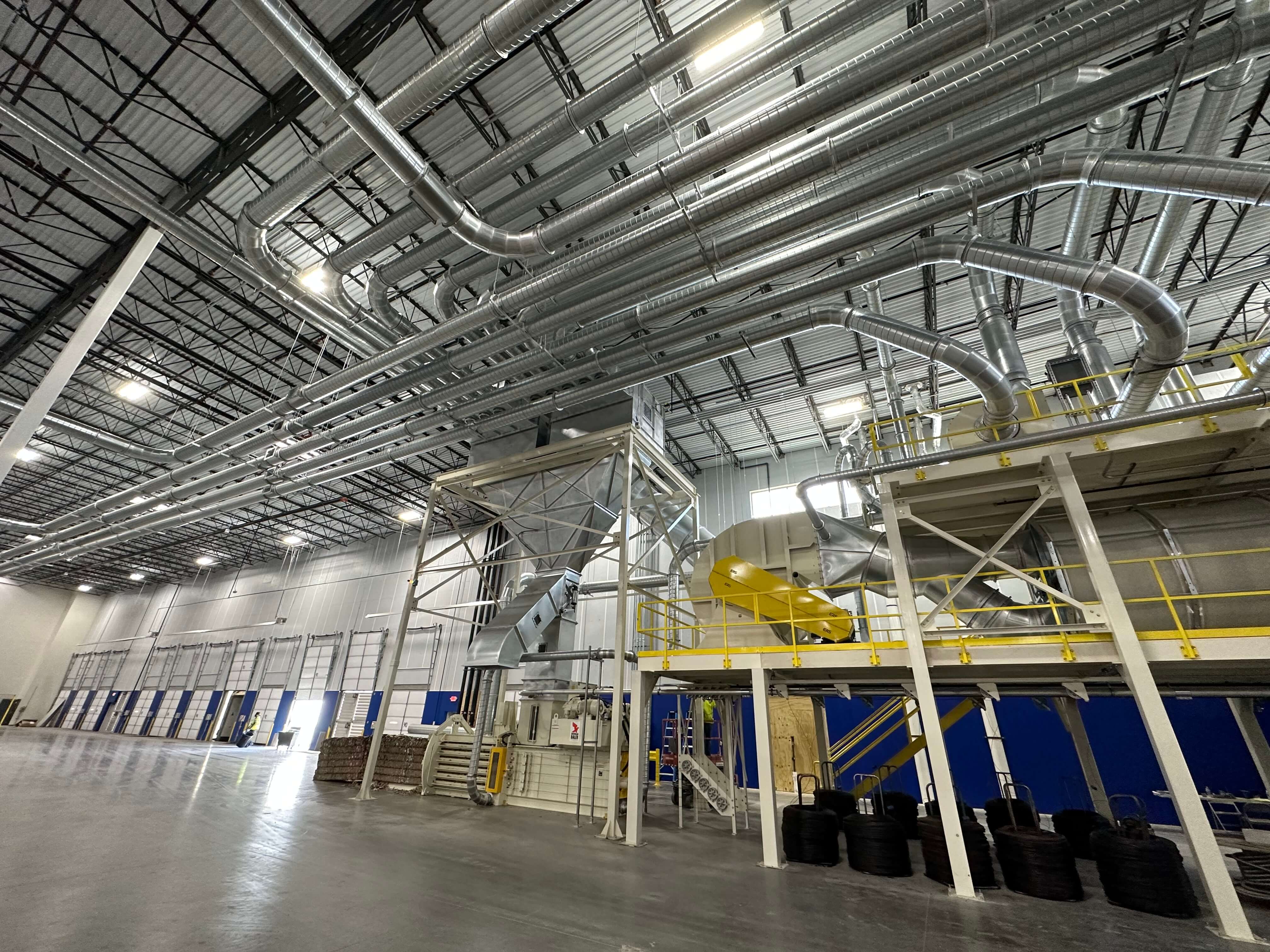
Combustible Dust Filtration Built In, Not Bolted On
Explosion venting, relief panels, an abort gate, a bunker outside the building — that is what a conventional dust collector has to be built around. The CCM® OCT filter is designed to reduce what the installation has to carry. Engineered Recycling Systems designs, builds and supports it from Atlanta.
Why conventional collectors need venting
A pulse-jet collector works on suction and cleans its media with blasts of compressed air. That combination — negative pressure, moving air at speed, a dust cloud inside an enclosure — is what the venting, the relief panels and the abort gate exist to manage.
So the safety equipment is added to contain a risk the machine's own design creates. It works, and it is expensive, and it usually ends up outside the building because that is where the codes want it.
The CCM® OCT approach
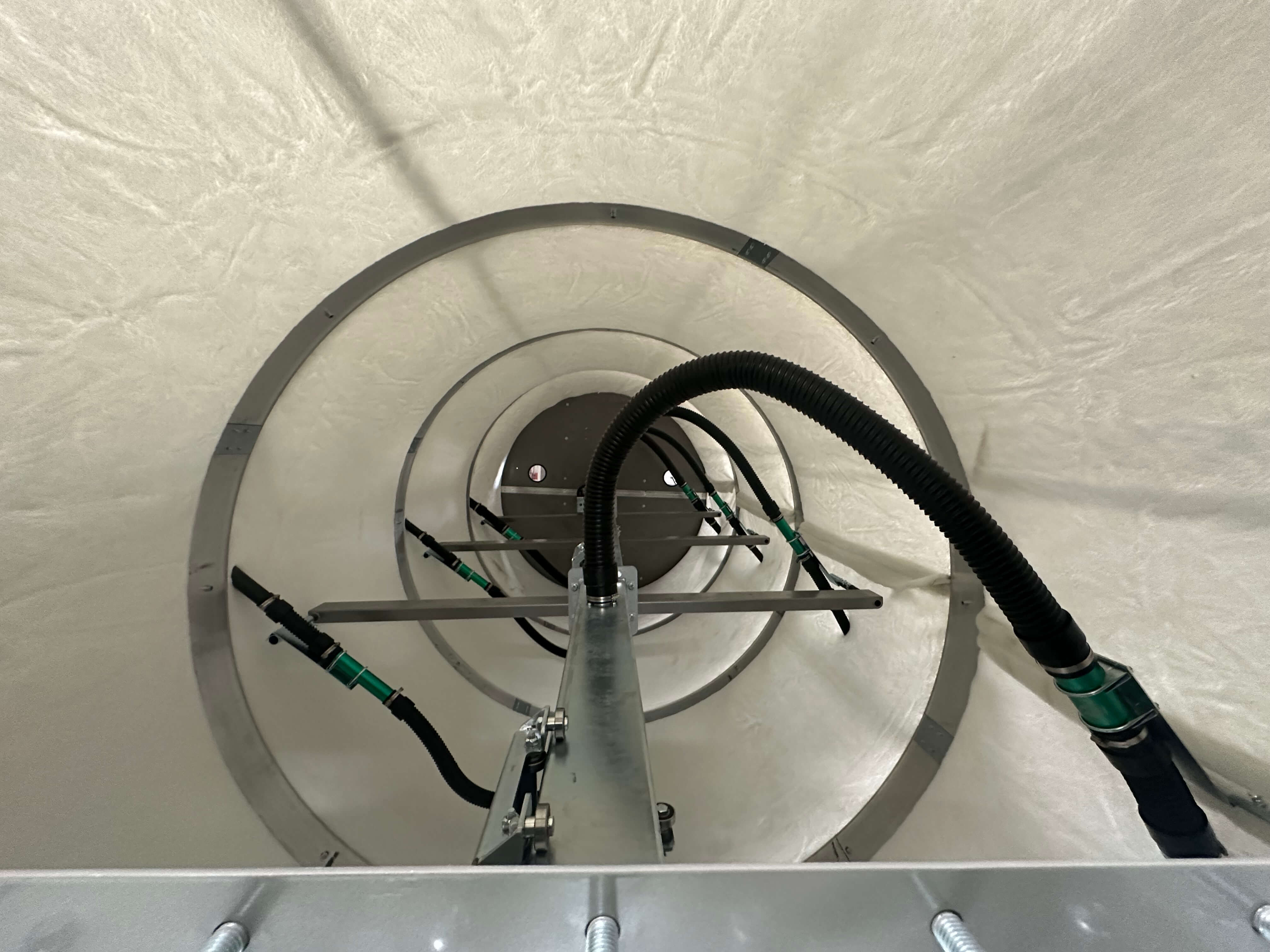
The CCM® OCT filter runs on the pressure side. Dust-laden air enters the cylinder and is cleaned continuously by traversing suction nozzles, with no compressed air and no pulse cycle.
Internals are antistatic and grounded — the suction nozzles and the nozzle hoses included — so static cannot build and discharge inside the dust cloud. Removing the ignition source is a different strategy from containing an ignition.
Nothing electrical inside the drum
The single gear motor sits on the outside of the back wall, out of the dust-laden air. Inside the drum there is no motor, no electrics and no compressed air: the nozzle traverse is purely mechanical.
The motor itself is rated for the duty — Class II Division 2, Groups F and G, T3B — which is the specific rating a combustible dust environment calls for rather than a general assurance.
What that changes in the building
The unit is designed to be installed inside a production facility, which changes the ducting, the wall penetrations and the clearance zones a combustible dust installation normally demands. Installation cost falls and the facility layout gets simpler.
It also makes direct sprinkler coverage straightforward, and the filter can be visually inspected through its windows while it is running. Both are easier to demonstrate to an inspector than a vented unit in a yard.
What it does not claim
No filter removes a combustible dust hazard. Dust plus oxygen plus an ignition source is the hazard, and a plant handling combustible dust still has one. What this design does is take the ignition sources out of the collector.
ERS engineers each installation to the standards that apply to that plant, and reviews it on site. That is a narrower claim than it sounds, and it is the one ERS will stand behind in front of a fire marshal.
Where NFPA 660 comes in
NFPA 660 consolidates the combustible dust standards, and it is the document a plant's dust collection will be assessed against. The CCM® OCT design points — grounded and antistatic internals, positive pressure, no compressed air, inspectable in operation — are the ones that matter in that assessment.
ERS will go through the standard against your specific dust and layout. What applies depends on the material, the quantity and the building, which is why the answer is a conversation rather than a specification sheet.
Which dusts this is for
Paper and corrugated dust, tissue and cellulose fiber, board dust from sheeting and finishing, and dust off metals processing lines.
Aluminum and other metal fines are the ones that concentrate minds, and they are also where grounding and antistatic construction stop being features and become the specification.
How it fits the rest of the system
The filter is the last stage. In front of it a cyclone separator or a low profile separator takes the coarse fraction out, and the trim removal system handles the scrap before any of it reaches the air.
Specifying the stages together is what makes the safety case coherent. A filter fed by undersized ducting that drops dust along its length has moved the hazard rather than removed it — see industrial dust collection.
Maintenance, and why it matters here
Media panels change tool-free in about four to six minutes each. There is no manual cleaning cycle and no shutdown to clean the filter, because it cleans itself while running.
On a combustible dust system that is a safety point as much as a convenience one. Accumulated dust is the hazard, and a filter that holds its airflow does not let the ducting load up between services. Parts are stocked in Atlanta — spare parts and service.
Compliance note
CCM® OCT filters are engineered to reduce what a combustible dust installation normally has to be built around. ERS engineers each installation to the standards that apply to that plant, and reviews it on site with you and your authority having jurisdiction.
ERS does not sign off a plant's dust hazard analysis. What ERS does is supply equipment whose design makes that analysis easier to pass, and work through it with you.
How a project starts
With your dust, your air volume, your building and whatever your last inspection flagged. Material can be run at the ERS test facility in Atlanta.
Talk to ERS about your combustible dust and what your current collector requires you to build around it.