


Dump and Run The Operator Never Touches the Shredder
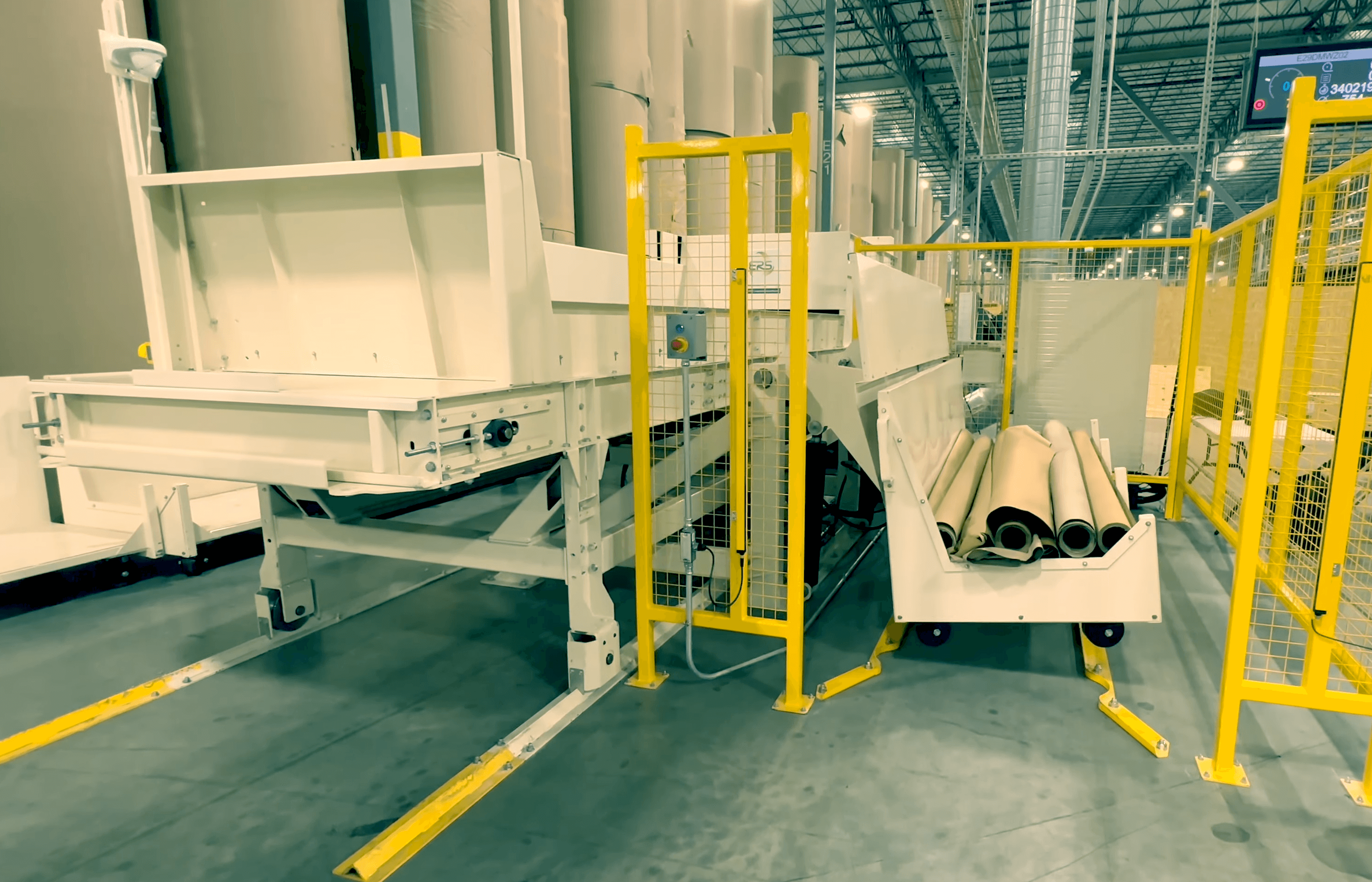
The AFS-1500 Dump and Run Shredder processes paper cores, flat corrugated sheets and leftover roll scrap without anyone feeding it by hand. An operator wheels a loaded cart into position and walks away; the machine lifts it, empties it onto the conveyor and shreds the contents. Engineered Recycling Systems designs, builds and supports it from Atlanta.
What "dump and run" means
Cores are awkward. They are long, they are heavy, and the usual way to shred them is for somebody to lift them into an infeed one at a time. That is the slowest and least safe job on the line.
The AFS-1500 replaces it with a cart. Fill the cart wherever the cores accumulate, bring it to the machine, position it and leave. The lift, the dump and the shredding happen without anyone standing at the machine.
Why that matters more than the throughput figure
Manual core feeding is a repeated lifting task next to a cutting machine. Taking the operator out of that cycle removes the exposure rather than guarding it, which is a different and better answer.
It also changes who can do the job. A cart anyone can wheel across a plant is not the same task as lifting cores into a hopper, and it stops being a two-person operation.
What it handles
High volumes of core waste and corrugated board scrap, consistently. Cores from paper mills and converting operations, flat sheet off corrugated and board lines, and roll ends that are too short to run.
Those are the three things that accumulate in a corner of every paper plant and get dealt with late. A machine that takes them as they come, in a cart, is what stops the corner filling up.
What happens after the shredder
Shredded material travels through ducting to a cyclone separator, where the dust is taken out and the output is left clean and ready for compaction.
An integrated baling press bundles it for disposal or for sale, so the line ends in a bale rather than in a pile. Where a plant already has a trim removal system, the AFS-1500 feeds into the same back end.
Dust is part of the design
Shredding cores makes fiber dust. The cyclone takes the bulk of it, and behind that the dust collection stage handles the fine fraction — on continuous duty that is usually a CCM® OCT filter.
Designing the dust out at the shredder is cheaper than cleaning it up afterwards, and on combustible fiber dust it is also the point at which the safety case is either made or missed.
How the machine is guarded
Sensors, light curtains and a remote-access camera monitor every stage, so operators can watch what the machine is doing without entering the work zone.
The design is enclosed and the logic is automated: the sequence runs on its own and stops on its own if something is where it should not be. That is what allows the operator to be elsewhere while it runs.
Safety standards
The enclosure, the interlocked guarding, the light curtains and the dust control are standard rather than options, and they are the features that carry the safety case on this machine.
What applies to a specific installation depends on the plant, the material and the local authority having jurisdiction. ERS engineers each installation to the standards that apply to that plant and reviews it on site — a machine makes compliance achievable, it does not grant it.
What it replaces
Usually a manual shredder and a pair of hands, or no shredder at all and a baler being fed cores whole. Both are slow, and the second one wastes baler capacity on air.
Shredding first means a denser bale, fewer bales and lower haulage. On a plant producing cores all day that is a recurring saving rather than a one-off.
Where it fits in the plant
Near where the cores accumulate, which is usually the back end of the converting lines rather than the baling area. The cart does the travelling, so the machine does not have to sit in the main traffic route.
ERS integrates it with conveyors, the separation stage and the baling press as one system, so the stages balance instead of one of them waiting.
How a project starts
With your cores — how many, what diameter, what wall thickness — and where they currently end up. Those three answers size the machine and decide where it goes.
Material can be run at the ERS test facility in Atlanta. Every system ERS supplies is installed, commissioned and supported by ERS, with spare parts and service from Atlanta.
Talk to ERS about how your cores are handled now and who is lifting them.