


Cyclone Separators The First Stage That Protects Everything Behind It
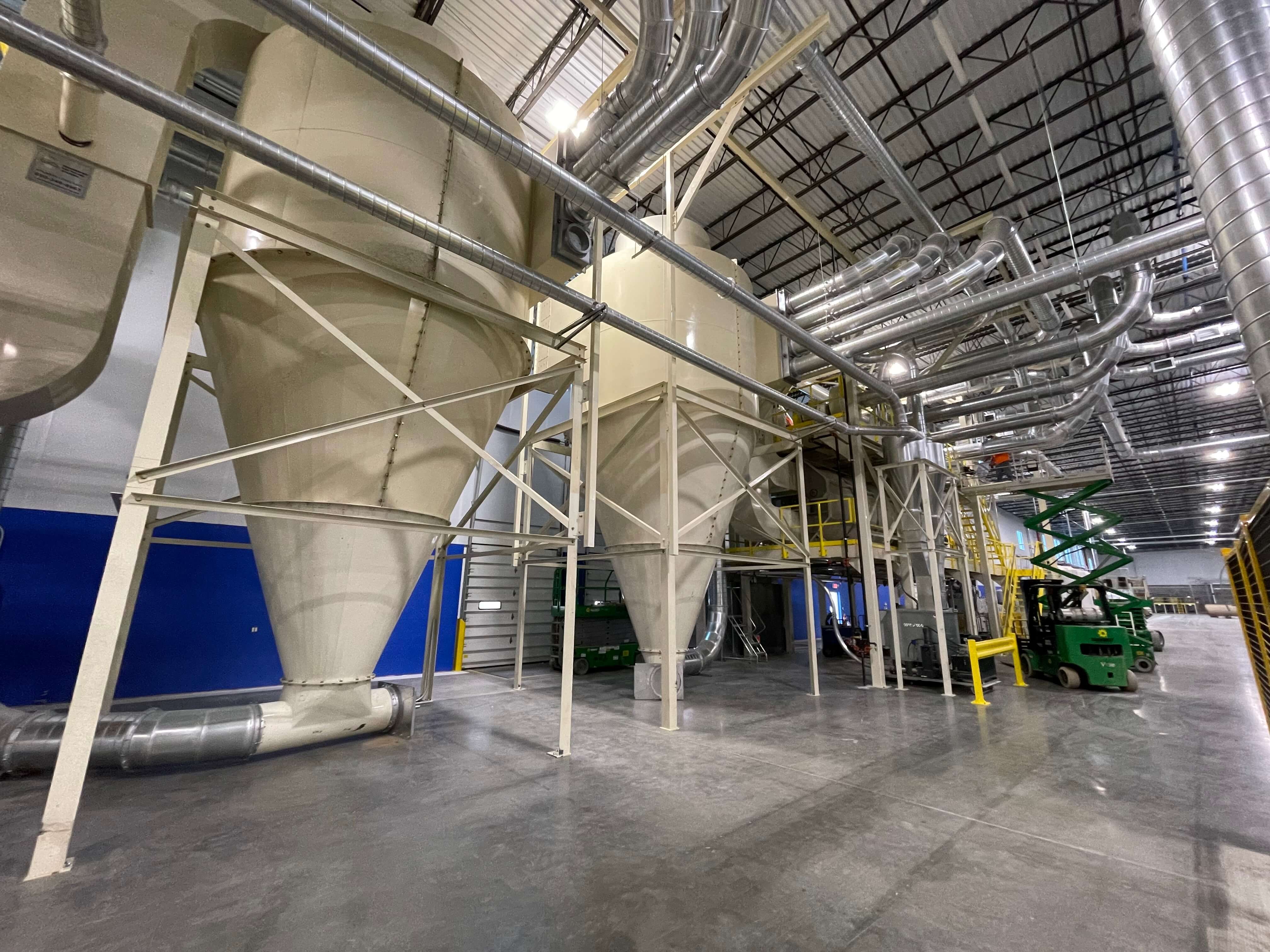
Cyclone separators from Engineered Recycling Systems take the heavy fraction out of a high-volume airstream before it reaches the filter. They are the cheapest stage in a dust collection system and the one that decides how long everything behind them lasts. Designed, installed and supported from Atlanta.
What a cyclone actually does
Air enters the body tangentially and spins. Heavier particles are thrown to the wall, lose velocity and drop out of the bottom; the lighter air carries on to the filtration stage with most of the load already gone.
There are no moving parts in that process, which is why a correctly sized cyclone will run for years with almost no attention. It is also why it is the first thing worth getting right.
Why the pre-separation stage earns its keep
A filter fed the full dust load works harder, blinds faster and needs its media changed sooner. Put a cyclone in front and the filter sees a fraction of the particulate, holds its airflow longer and runs at lower pressure drop.
Lower pressure drop is lower energy. On a system running continuously, the fan is the largest electrical load in the installation, and the cyclone is what keeps it from working against a loaded filter.
There is a housekeeping argument too. The fraction a cyclone drops out is coarse and easy to handle, so it leaves the building as one clean stream instead of arriving at the filter and having to be dealt with as fine dust later.
High-efficiency particle separation
Cyclonic airflow design separates heavier particles before the filtration stage, reducing filter wear and maintenance. How well it does that depends on getting the body geometry matched to the actual particle size and air volume.
That is the part that cannot be bought off a shelf. The same cyclone on two different dust loads performs quite differently, which is why ERS sizes them against the plant's own material.
Rugged construction
Fabricated from heavy-duty materials to take high airflow volumes and abrasive dust. Abrasion is what ends a cyclone's life, and it concentrates where the airstream first hits the wall.
On coated paper, board or metals work the abrasive content is high enough that material choice and wall thickness matter more than they would on clean fiber. Specifying for the worst material rather than the typical one is the difference between a decade and a few years.
That is also the economic argument. Metal fines, grit and granulated plastic will wear filter media long before they wear a steel cyclone body, and media is a recurring cost while the cyclone is a one-time one.
When headroom is the problem
Where there is not height for a cyclone, ERS specifies a low profile separator instead. It does the same job in a fraction of the height, which is what makes it the usual choice on a mezzanine or under an existing roof.
Behind either one, continuous operations get the CCM® OCT filter, and in combustible dust applications ERS builds the filtration to match the hazard. That is a decision taken against the dust, not against the budget.
Flexible integration
A cyclone can be a standalone separator or the pre-cleaner in a multi-stage system, and it scales with the process. ERS fits them with conveyors and discharge handling so the collected fraction goes somewhere useful rather than into a drum someone has to empty.
On trim systems the discharge usually goes to the baler chute, which consolidates the waste into one stream, see trim removal and dust collection.
Low maintenance by design
No moving parts and minimal maintenance requirements make a cyclone the reliable first line of defense in a dust control strategy. Inspection is a visual check of the wall and the discharge, not a strip-down.
Compare that with the stage behind it. A CCM® filter cleans its own media continuously, but it still benefits from being fed less, and the cyclone is what feeds it less.
Optimized performance
Engineered for efficiency against airflow volume, dust type and plant layout, which reduces pressure drop and energy consumption. Layout matters as much as the figures: a cyclone in the wrong place on the duct run will underperform a smaller one correctly positioned.
Those three inputs are what ERS asks for before sizing anything, and they are also what a plant usually has not measured.
Body diameter is the critical dimension. Efficiency comes from velocity and velocity comes from matching the diameter to the airflow: oversize it and the material never separates properly, undersize it and the pressure drop costs fan energy every hour the plant runs. A cyclone is specified against the duct system, not from a catalog.
Where ERS puts them
Paper and trim handling systems across paper mills, paper converting, corrugated and paperboard.
Plastics and flexible packaging production, where the dust is static-laden rather than fibrous. Wood and insulation dust control. And on the metals side, after pre-shredding, granulating and pneumatic conveying, where a cyclone is how the material comes out of the air at the end of a transfer line.
Which dusts suit it
Fibrous, granular and abrasive particulate, paper, plastic, wood and metal processing dust. The coarser and heavier the fraction, the more work the cyclone does and the less the filter has to.
Very fine dust is the limit. A cyclone will not capture the finest fraction, which is exactly why it is a pre-separation stage and not a replacement for filtration.
Anyone offering a cyclone as a complete dust collection solution is selling the wrong thing. It is one stage of several, and on converting work or tissue and hygiene production the fine fraction is the one the regulations care about.
How a project starts
With your airflow volume, your dust type and your plant layout. Material can be run at the ERS test facility in Atlanta where the dust is unfamiliar or the split matters.
ERS designs the cyclone as part of the whole installation rather than as a component, hoods, ducting, separation, filtration and fans together, across both the converting side and metals processing.
Every system ERS supplies is installed, commissioned and supported by ERS, with spare parts and service from Atlanta.
Talk to ERS about what your filters are currently handling that they should not be.
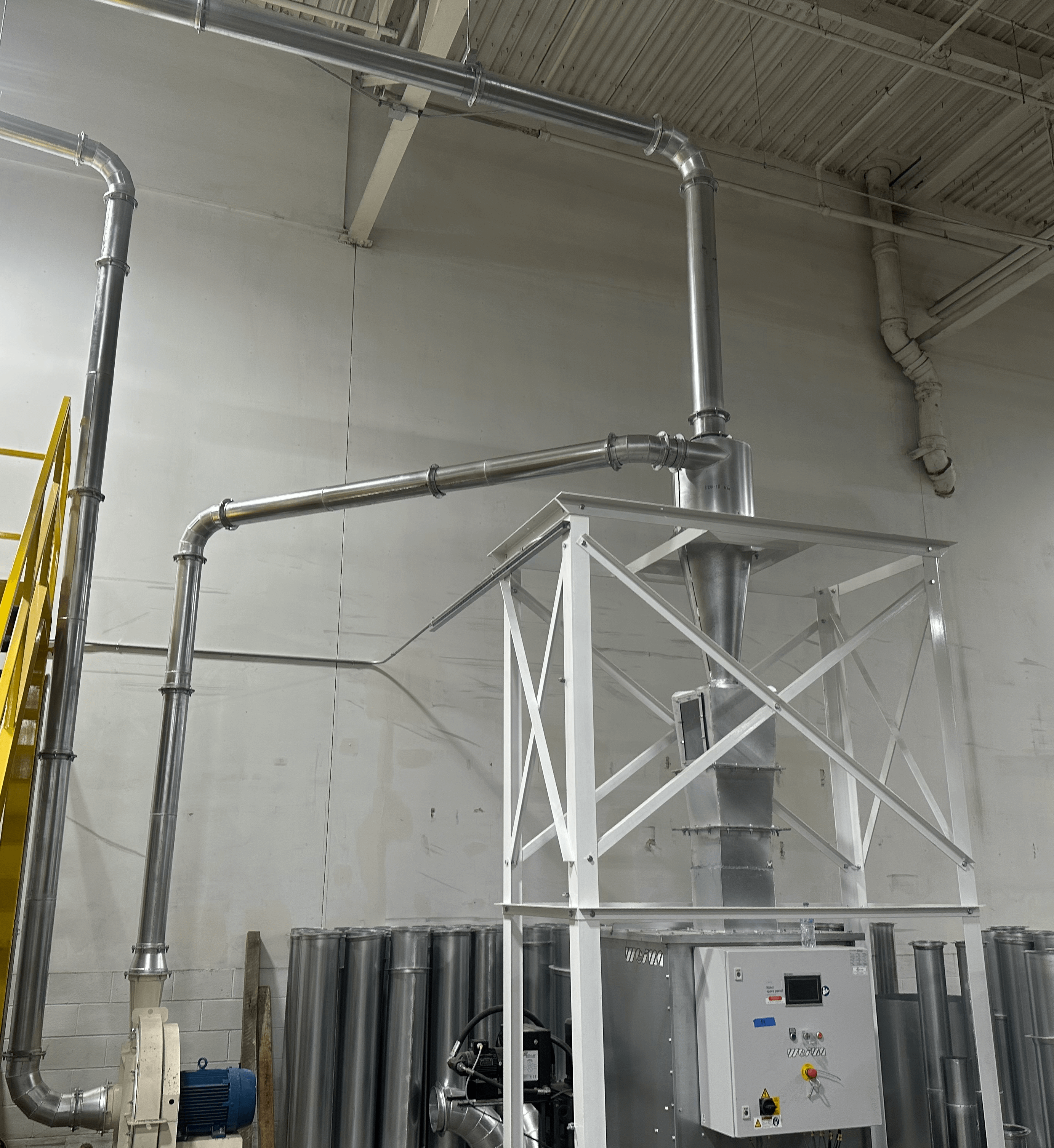
Applications
ERS Cyclone Separators are ideal for:
- Paper and trim handling systems
- Plastics and flexible packaging production
- Wood and insulation dust control
- Shredding, granulating, and conveying systems
- Pre-cleaning before fine filtration stages
Reliable Dust Control Starts with Smart Separation
Whether you're dealing with fibrous trim, coarse dust, or heavy particulate, Engineered Recycling Systems delivers cyclone separator solutions tailored to your plant's needs. Improve your air quality, protect your downstream filters, and support the standards that apply to your plant.
Application in various industrial sectors
- Corrugated
- Paper & cellulose
- Recycling
Advantages
- High separation efficiency
- Easy separation of fine and finest particles
- Continuous operation
- Robust design
- Can be operated with positive or negative pressure
- Reduction of pressure loss through a pressure regain piece in the top portion
- Exact adaptation to any air volume due to an extensive variety of available sizes