


Self-Adhesive Matrix The Hardest Waste in Converting
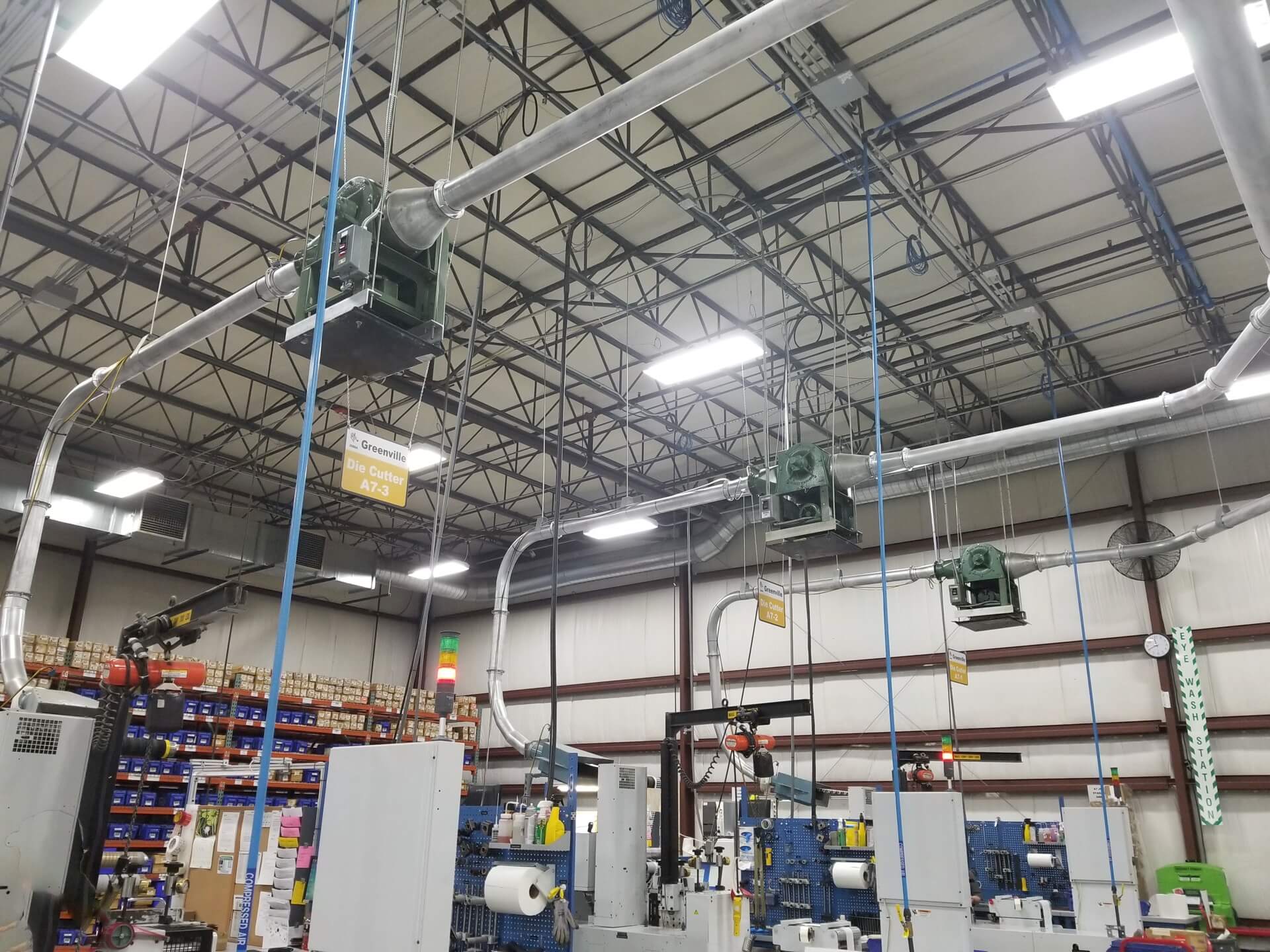
Matrix trim extraction systems from Engineered Recycling Systems are built for label converting: narrow-web presses, die cutters, slitters and high-speed finishing lines. Matrix conveyance, edge trim separation and CCM® dust filtration in one system, designed, installed and supported from Atlanta, and specified around the material rather than the machine.
What matrix is, and where it comes from
A pressure-sensitive label starts life as a laminate: printed face stock on top, adhesive underneath, and a silicone-coated liner carrying the whole web. The press prints the face stock, then the die cuts the label shape through the face stock and the adhesive, but not through the liner.
The labels themselves stay exactly where they are, stuck to the liner, ready to be rewound and shipped. Everything around them lifts away as one continuous skeleton of printed face stock and adhesive. That skeleton is the matrix.
So matrix is not a paper by-product that happens to be tacky. It is the scrap a plant makes every single time it runs labels, and the faster the line runs the more of it arrives, without pause, for as long as the job is on the press.
Why matrix is the hardest waste in a label plant
Matrix is self-adhesive by definition. It is thin, it is light, and it sticks: to the duct, to itself, and to anything it touches on the way. Nothing else in a converting plant behaves like it.
That is why a system that handles paper trim perfectly will block on matrix within a shift. The velocity has to be high enough to keep it moving, and the routing has to give it nowhere to settle.
Matrix wraps, and what they cost
A matrix wrap stops the press. On a narrow-web line running die-cut work that is not just lost minutes. The web has to be re-threaded and the die re-registered before the job restarts.
High-velocity trim and matrix conveyance is specified to prevent that: no clogging, no tailing, no airflow instability, at the speeds the line actually runs rather than the speed on the nameplate.
The materials
Pressure-sensitive adhesives, delicate liner stocks and specialty label materials. Liner is the fragile one, thin enough to tear if the suction at the cut is wrong, which makes the airflow window narrow.
Adhesive is the persistent one. It carries into the dust load, coats the inside of ducting over time and changes how a filter behaves.
Adhesive type matters as much as the stock. A hot-melt behaves differently in a duct from an acrylic, and a plant that changes adhesive to win a job has changed what its extraction system is handling.
Which machines it serves
Narrow-web presses, slitters, die cutters, rewinders and high-speed finishers. Stable conveying supports consistent die-cutting and rewinding, which is where label quality is actually decided.
Most label plants run several presses of different ages side by side. One extraction system has to serve all of them without the oldest line dictating the design.
Web width is the other spread. A plant running six inches on one press and sixteen on the next has two different matrix volumes arriving at the same system, and both have to clear.
Compact separators and diverters
Separators and diverters direct matrix and trim into bins or balers while keeping work areas clear and the footprint small. They integrate with presses, slitters and finishing equipment as they stand.
Label plants are space-constrained almost without exception. A separator that needs floor space will displace something that earns money, so compactness is not a refinement here.
CCM® OCT filtration
ERS dust collection uses CCM® OCT Filter Technology, which captures fine dust and airborne adhesive particles from slitting, die-cutting and rewinding, cleaning the media continuously without compressed air and without manual cleaning.
Low pressure loss, stable airflow and long media life, with collected dust discharging through a cyclone separator.
Adhesive particulate is what kills a conventional filter on label work. It does not shake off, so a filter cleaned on a cycle blinds progressively while a continuously cleaned one does not.
What happens to the matrix after extraction
Getting matrix off the press is half the job. The other half is what it does once it is inside the system, and this is where matrix stops behaving like ordinary trim. It is silicone-coated and tacky, so it does not drop cleanly, it does not settle in a container the way clean trim does, and it will bridge in a chute that would never block with corrugated.
ERS designs the discharge for that behavior rather than hoping it falls out: the drop points, the container and the way the material is compacted are specified around a sticky web. Where the same plant also runs clean trim and dust, those streams are kept separate, because mixing them turns two saleable fractions into one that is neither.
On a plant running both, the clean trim goes to a baler and the fine dust from slitting and sheeting goes to a briquette press, while the matrix takes its own route. One system, three answers, decided by what each stream actually is.
Whole-system scope
Trim removal, air dust collection and scrap system dust collection, designed together as one engineered system rather than three purchases from three suppliers.
Where cores have to be handled, a core shredder goes in alongside, which on a label plant producing cores by the hundred is worth having.
The rest of the converting side
ERS covers flexible packaging, which shares the static and thin-substrate problems, plus paper converting, commercial printing and direct mail.
On the heavier side there is paperboard, corrugated and folding carton, with paper mills upstream and converting dust collection alongside.
What label converters get out of it
No matrix wraps, which is the failure that costs most on a narrow-web line. Clean work areas, which matters when the product is handled. And minimal operator intervention, because nobody should be clearing matrix by hand at these speeds.
Air quality is the other half of it. Adhesive dust in an occupied room is a workplace issue, and on specialty materials it can contaminate the product as well.
How a project starts
With your presses, your materials and your web speeds. ERS surveys the plant before quoting, because on matrix the routing decides whether a system works and the routing depends on the building.
Material can be run at the ERS test facility in Atlanta, which on self-adhesive matrix is worth doing before anything is specified. Every system ERS supplies is installed, commissioned and supported by ERS, with spare parts and service from Atlanta.
Talk to ERS about your presses, your materials and where matrix is stopping your lines.