


From Parent Roll to Log Saw
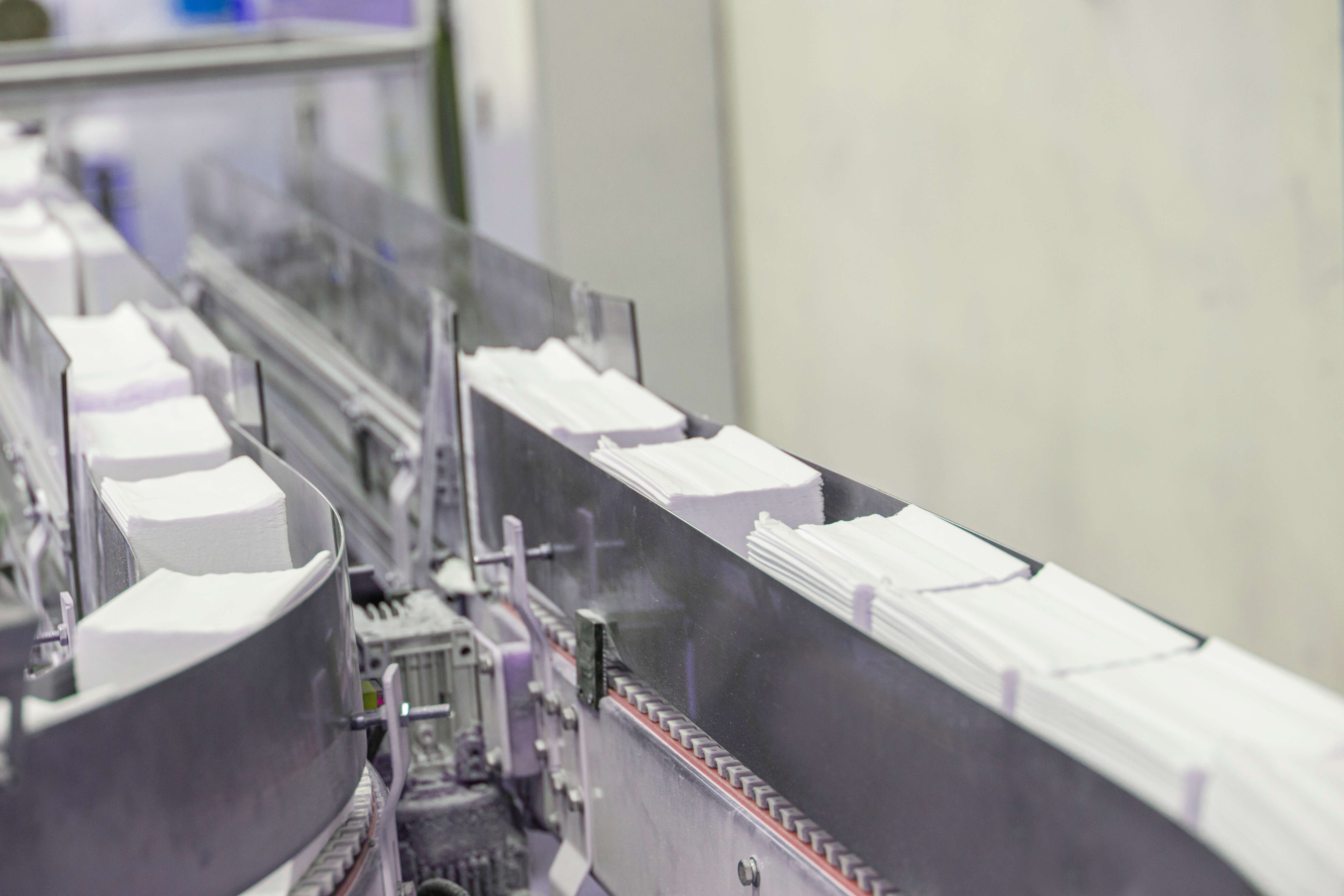
Tissue converting facilities trim removal systems deal with the lightest material in the paper business. Tissue fiber does not fall, it floats, and it travels the whole building before it settles. ERS captures trim, scrap and airborne fiber from the parent roll unwind through to the log saw, and engineers the conveying, separation and filtration behind it as one system.
Every Station Makes a Different Kind of Dust
Unwinding releases loose fiber from the parent roll. Embossing and perforating throw fine particulate. The log saw is the heaviest single dust source on the line, and it produces it in bursts rather than evenly. Rewinding and packaging add trim and lightweight scrap on top. A system sized on an average across those stations will be wrong at every one of them.
ERS sizes hoods, pick-up velocity and duct runs station by station, so the log saw gets what the log saw needs without starving the rest of the line.
Why Hygiene Production Is Different
In tissue and hygiene production, loose fiber is not only a housekeeping problem. It lands on product, it works into bearings and drives, and it is the first thing an auditor looks at. Capturing it at source rather than sweeping it up later protects product quality, keeps machinery clean and holds line speed where it should be.
The CCM® OCT Filter
High fiber loads are exactly what the CCM® OCT filter is built for. It cleans itself continuously while the line keeps running. One gear motor sits outside the filter, out of the dust, and turns the central shaft and the boom. The nozzle traverse takes its motion from that rotation mechanically, so nothing electrical moves inside the drum and no compressed air or water is needed for cleaning. Scrapers turn with the shaft and wipe fiber off the rings back onto the media.
The result is stable airflow and low pressure loss across a shift instead of a filter that slowly blinds between cleans. A media change is tool-free at roughly four to six minutes per panel, which matters on a line where the maintenance window is measured in minutes.
Separation and Baling
Trim and scrap come out of the airstream before they reach the baler. The Low Profile Separator does that in a fraction of the height a conventional cyclone needs, which is usually the deciding factor in a converting hall that was never designed around a waste system. Where headroom allows, ERS builds conventional cyclone separators into the same position. Downstream, ERS supplies and integrates the industrial balers as part of the same installation.
The Air Side
The air moving all of this has to be cleaned too. ERS builds vacuum transfer air dust collection — the dust collection on the air coming off the transfer system — sized for the whole plant running at once rather than for a half-loaded line. For facilities running several converting lines, ERS designs turnkey waste conveyance and dust collection systems that bring every station into one engineered waste stream.
Plants that need the air handling addressed on its own will find the detail under dust collection for paper, tissue and hygiene production.
Compact Footprint, Short Maintenance
Tissue converting halls are rarely generous with space. ERS designs for the footprint that exists, using compact separators and routing duct where the building allows rather than where a standard drawing would put it. Tool-free filter access and simple inspection keep the maintenance routine short, and the air quality requirements that apply to the plant are worked through with the plant and its insurer site by site.
Built Around the Line in Front of Us
Line speeds, product grades, the number of log saws and the position of the baler all change the answer. ERS engineers to those conditions rather than to a package. The wider equipment range sits on the paper converting systems page, and the complete chain is described under trim removal and vacuum transfer air dust collection.
The same engineering serves the neighboring paper industries: paper mills, corrugated box plants, folding carton converting, paperboard production, paper converting, commercial printing, flexible packaging, label converting and direct mail manufacturing.
Service and Spare Parts
A dust system on a hygiene line is worth what it does in year five. ERS keeps a stocked warehouse and supports every installation it builds, from commissioning through to spare parts and service. Filter media, wear parts and fan components are available without a lead time measured in months.
Next Steps for Your Tissue Converting Dust Control Project
If you are evaluating tissue converting facilities trim removal systems or planning an upgrade to an existing line, send the details through the contact form. ERS will review the line speeds, the stations and the available space and come back with a system configuration that fits.