


Paper Cores In A Baleable Fraction Out
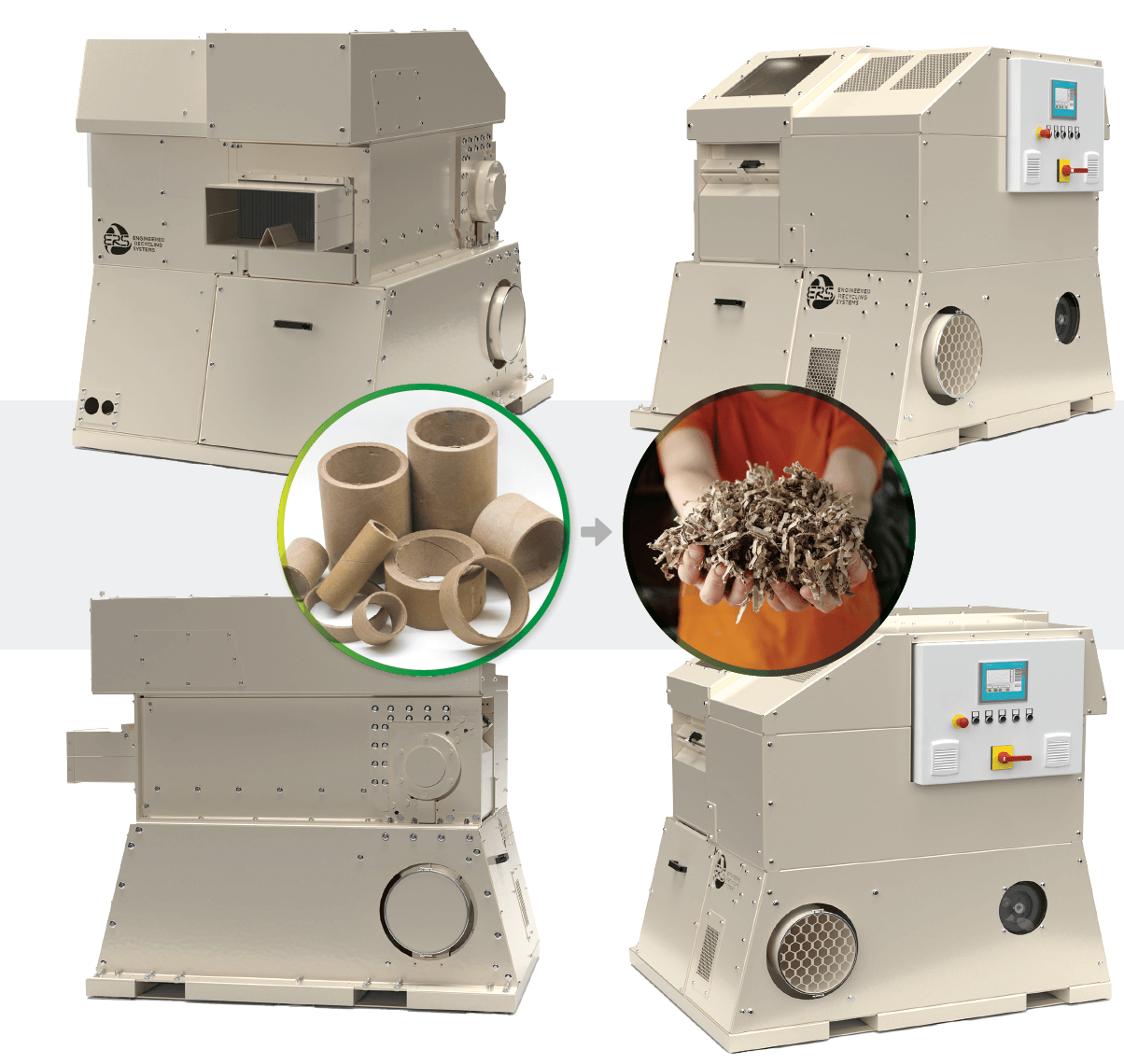
The PMG 400 Paper Core Shredder turns spiral-wound paper cores into a uniform fraction ready for recycling. It is the machine for corrugated plants, tissue converting operations and paper mills where cores pile up faster than anyone can deal with them. Engineered Recycling Systems supplies, installs and supports it from Atlanta.
The problem it exists for
Cores accumulate. Leftover cores from corrugated production, cores from tissue converting, cardboard cores in a mill, they are bulky, they are awkward to stack, and they take up floor space that was meant for product.
Then they cost money to remove, because a trailer full of whole cores is mostly air. Shredding them first is what makes the haulage economic.
What it takes
Dense cores up to 6½ inches in diameter, and it will take them with half an inch of paper still wound on. That last detail matters: a core that has to be stripped first is a manual job, and a machine that only accepts clean cores creates one.
Two cores every 60 seconds, continuously, which keeps up with a production line rather than being fed between other tasks.
How it cuts
A single-shaft rotor, 9 inches in diameter, running at 92 RPM. The cutting chamber has ten reversible 40 mm blades and a reversible bed knife, which gives consistent reduction and doubles the life of the cutting edges before they are replaced.
Low rotor speed is what produces a uniform fraction rather than a mix of chunks and dust, and it is also why the machine is quiet.
17 HP, and under 85 dBA
The 17 HP motor is modest for the work, which keeps the running cost down on a machine that may be on all shift. Noise stays below 85 dBA.
That figure is worth noting rather than skipping. Below 85 dBA is the threshold where hearing protection requirements and noise exposure monitoring start, so a core shredder that stays under it can sit in an occupied area without changing the plant's noise regime.
What comes out
A uniform shredded fraction that bales densely and has a buyer. Whole cores do neither.
From there it goes into the existing back end: ducting to a cyclone separator to take the dust out, then to a baler. Where a plant already runs a trim removal system, the core shredder feeds the same equipment.
Dust
Shredding paper makes fiber dust, and a core shredder in an occupied area needs that handled rather than mentioned. Dust collection is specified with the machine, and on continuous duty that usually means a CCM® OCT filter behind the cyclone.
On combustible fiber dust there is a safety case as well as a housekeeping one, see combustible dust filtration.
Where it goes in
In corrugated plants, where cores come off the converting lines all day. In tissue converting, where the roll cores are the waste stream. And in paper mills, where the cores are the heaviest of the three.
Also in paperboard and paper converting operations running the same materials at different scales.
Where it sits in the plant
Near where the cores actually accumulate, which is rarely the baling area. Its footprint is small enough to put it at the end of a line rather than in a dedicated bay.
ERS integrates it with conveyors and the separation and baling stages so it is part of a line, not a machine somebody has to carry waste to. Where cores arrive in volume and manual feeding is the bottleneck, the AFS-1500 Dump and Run Shredder automates the loading as well.
What it changes
Smoother scrap handling, less storage taken up by cores, lower disposal costs and a fraction that can be recycled rather than removed.
For tissue producers it also turns a waste line into a recycling stream, which is the part that appears in a sustainability report. For mills and corrugated plants the argument is simpler: fewer trailers.
Wear and maintenance
Blades and the bed knife are the consumables, and both are reversible, turn them once before replacing. That is a straightforward saving and it is designed in rather than offered as an upgrade.
Parts are stocked in Atlanta, with spare parts and service from the same place the machine is supported.
How a project starts
With your cores: how many a shift, what diameter, how much paper is left on them, and where they end up now. Those four answers size the installation.
Material can be run at the ERS test facility in Atlanta. Every machine ERS supplies is installed, commissioned and supported by ERS.
Talk to ERS about how many cores you are moving and what it costs you to get rid of them.