


Briquette Press TH-Series
The briquette press TH-Series compacts loose waste into solid blocks with no binder, no glue and no additive. Wood chips, sawdust, shavings, paper dust and metal fines go in loose and come out as a dense briquette roughly the size of a hockey puck. Engineered Recycling Systems supplies and installs them from Atlanta.
How the machine works
Material drops into the hopper, either by hand or straight from the collection system. An agitator keeps it moving toward an opening in the base, an auger fills the pressing chamber, and a hydraulic cylinder densifies it into a briquette.
Nothing is added. The briquette holds together on compaction alone, so what comes out is a clean, reusable product rather than a mixture.
Why briquette rather than handle loose
Loose dust is expensive in ways that rarely appear on one invoice. It fills containers at almost no weight, so haulage is paid on air. It needs enclosed handling. It spreads through the plant, and it has to be swept up from places it was never meant to reach.
A briquette is a fraction of the volume of the material that went into it. The same container holds far more, and the material becomes something that can be stacked, stored and in many cases sold rather than paid to remove.
Where the press sits
Directly underneath the dust collection system. Material discharges from the filter or the cyclone separator straight into the press, so there is no intermediate bin, no second handling step and nothing exposed to the building.
On the converting side that means the end of a trim removal system: fines and dust that a baler cannot take are briquetted instead. In corrugated, tissue converting and woodworking plants that is often the difference between a clean operation and a permanent housekeeping problem.
On the metals side the same machine handles grinding fines, turnings and swarf coming off shredders and mills, where briquetted material is worth substantially more per ton than loose fines.
What a briquette is worth
Most briquettes burn. Wood and paper briquettes are a legitimate heat source and are commonly used on site or sold on, which turns a disposal line item into either a saving or a small revenue.
Metal fines are a different calculation: briquetted swarf melts with lower loss than loose turnings, so the recovery rate at the furnace is better and the buyer pays accordingly. On wet machining streams the press also squeezes cutting fluid back out, where it can be collected rather than carried away with the scrap.
Where it sits in the range
The TH-Series is the general-purpose range that suits most plants. Below it sit the compact C 150 and C 170e; above it the continuous-duty TH 800 M and the TH 1500 M. The whole range is set out on the briquette press page.
What feeds it well
Consistency matters more than volume. A feed that is reasonably uniform in size compacts predictably; one that swings between fine dust and long shavings produces briquettes that vary in density and length. Where a stream is mixed, size reduction upstream through a shredder evens it out before the press sees it.
On metal-bearing streams, magnetic separation ahead of the press keeps tramp metal out of the auger rather than relying on somebody spotting it.
Maintenance and wear
The wear parts are where the material does the work: the auger, the pressing chamber and the die. Abrasive feedstock such as MDF dust or metal-bearing material shortens their life considerably compared with clean softwood shavings, which is worth knowing when the machine is specified rather than when the first parts are ordered.
Access is the practical point. A press installed hard against a wall under a cyclone takes twice as long to service, so ERS plans the position for the maintenance as well as for the duct run. Wear parts are held and supplied from Atlanta.
What changes on the floor
The visible change is space and haulage. Loose material fills a container long before it is anywhere near a full load by weight, so a plant pays for collections that are mostly air. Briquettes go into the same container at a fraction of the volume, which cuts the number of hauls as much as the tonnage.
Options that matter in practice
A level sensor so the press runs on demand rather than continuously. Hydraulic oil heating and cooling, which keeps performance consistent in an unheated building through a winter. Automatic length adjustment so the briquette matches whatever the downstream handling expects.
None of these are exotic. They are the things that decide whether the machine still works properly in its third year.
How a project starts
With the material. ERS looks at what the dust collection system is producing, in what volume, how wet it is and what happens to it afterwards. Material can be run at the ERS test facility in Atlanta, which matters here because how a material briquettes is genuinely hard to predict from a specification.
Every press is installed, commissioned and supported by ERS, with spare parts and service from Atlanta.
Talk to ERS about what your filter is dropping and where it currently goes.
Briquette Press TH-714
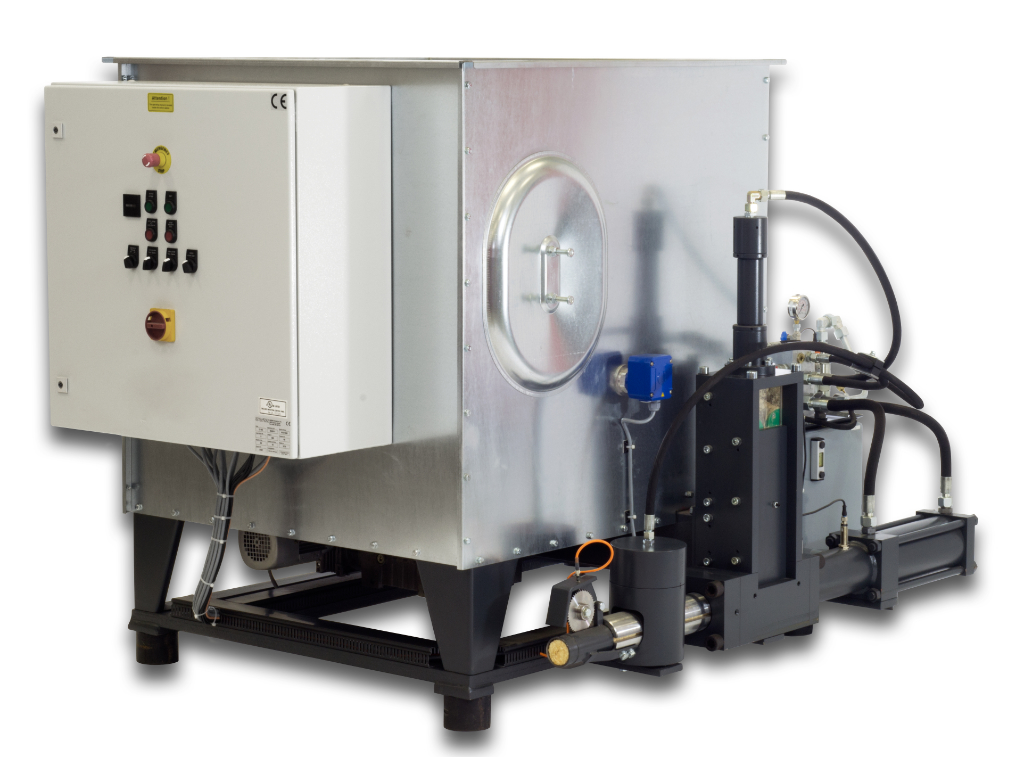
Technical Data TH-Series
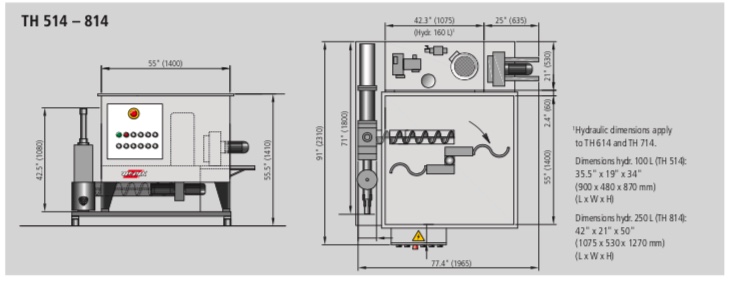
| TH 514 | TH 614 | TH 714 | TH 814 | TH814 S | |
|---|---|---|---|---|---|
| Weight | 2,094 lbs (950 kg) |
2,205 lbs (1,000 kg) |
2,425 lbs (1,100 kg) |
2,866 lbs (1,300 kg) |
3,858 lbs (1,750 kg) |
| Briquette Diameter |
2" (50 mm) |
2.4" (60 mm) |
2.8" (70 mm) |
3" (80 mm) |
3" (80 mm) |
| Hydraulic oil quantity |
26.5 g (100 L) |
42 g (160 L) |
42 g (160 L) |
66 g (250 L) |
132 g (500 L) |
| Hydraulic motor |
12 hp (9 kW) |
12 hp (9 kW) |
18 hp (13.3 kW) |
18 hp (13.3 kW) |
35 hp (26 kW) |