


Briquette Press TH 1500 M
The briquette press TH 1500 M is the largest machine in the range ERS supplies, built for heavy continuous production where metal chips, wood dust or paper dust arrive all shift rather than in batches. It compacts them into dense briquettes and, on wet machining streams, presses a large share of the cutting fluid back out.
Technical data
| Briquette dimensions | 5.9" x 2.4" (150 x 60 mm) |
| Weight, approximate | 7,716 lbs (3,500 kg) |
| Hydraulic motor | 40 hp (30 kW) |
| Hydraulic motor, filling cylinder | 7.5 hp (5.5 kW) |
| Worm motor | 0.75 hp (0.6 kW) |
| Permanent agitator | 3 hp (2.2 kW) |
| Oil quantity | 132 gal (500 L) |
What the size actually buys
The 40 hp main drive and the 7,716 lb frame are not there for a bigger briquette alone. They are what lets the press run at a steady rate through a full shift without the cycle time drifting as the machine warms up and the material varies.
The separate filling cylinder drive and the permanent agitator matter for the same reason. Material is moved into the chamber deliberately rather than relying on it falling in, which is what keeps briquette density consistent when the feed is uneven.
What it is for
Loose turnings, chips and dust take up a great deal of space for very little weight, so a plant ends up paying to store and haul air. Compacting them produces a dense, dry, stackable product that goes into the same container at a fraction of the volume.
No binder is used. The briquette holds together on compaction alone, so what comes out is a clean secondary raw material rather than a mixture.
Coolant recovery
On a wet machining stream the fluid pressed out of the chips is collected rather than carried off site with the scrap. Over a year that is a quantity worth measuring, and it also changes what the metal is worth — a dry briquette is weighed as metal rather than as metal plus fluid.
Where it sits in the range
The TH 1500 M sits above the TH 800 M, the TH-Series and the compact C 150 and C 170e. The whole range is set out on the briquette press page.
Choosing between them is a question of how much material arrives per hour and how consistently, not of which machine has the highest figure on paper. A press sized for the average stalls when the plant is busy; one sized for a rare peak spends its life below its design point.
What feeds it well
Consistency matters more than volume. A feed that is reasonably uniform in size compacts predictably; one that swings between fine grindings and long stringy turnings produces briquettes that vary in density. Where a stream is mixed, size reduction upstream through a shredder evens it out before the press sees it.
Tramp metal is the other thing to design out. A bolt or an offcut traveling with the chips reaches the auger eventually, so on mixed streams ERS puts magnetic separation ahead of the press rather than relying on somebody spotting it.
How it is fed
At this size the press is never hand-loaded. ERS builds the conveying in from the start so the machine is fed at a steady rate, and where the material is collected pneumatically it sits under the cyclone at the end of the dust collection system and takes the discharge directly.
Maintenance and wear
The wear parts are where the material does the work: the auger, the pressing chamber and the die. Metal-bearing feedstock is abrasive, so these are consumables, and their life depends heavily on what is being pressed rather than on hours alone.
Access is the practical point, and it matters more on a machine of this size. A press installed hard against a wall takes considerably longer to service, so ERS plans the position for the maintenance as well as for the duct run. Wear parts are held and supplied from Atlanta.
What changes on the shop floor
The visible change is space and haulage. Loose material fills a container long before it is anywhere near a full load by weight, so a plant pays for collections that are mostly air. Briquettes go into the same container at a fraction of the volume, which cuts the number of hauls as much as the tonnage.
The less visible change is handling. Loose chips and dust sit in open containers around the machines, get walked through, and end up on the floor between the machine and the skip. A press at the end of the collection system turns that into one predictable output at one point in the building.
Where it sits in the plant
A briquette press is the discharge end of something larger, which is why ERS specifies it alongside the collection and conveying it depends on as part of metals processing rather than as a machine bought on its own.
How a project starts
With the material and the numbers: what the stream is, how much arrives per hour, how wet it is, and where the briquettes and the recovered fluid need to end up. Material can be run at the ERS test facility in Atlanta when a question is better settled than estimated.
Every system ERS supplies is installed, commissioned and supported by ERS, with spare parts and service from Atlanta. Talk to ERS about your volumes and your coolant.
Technical Data TH 1500 M
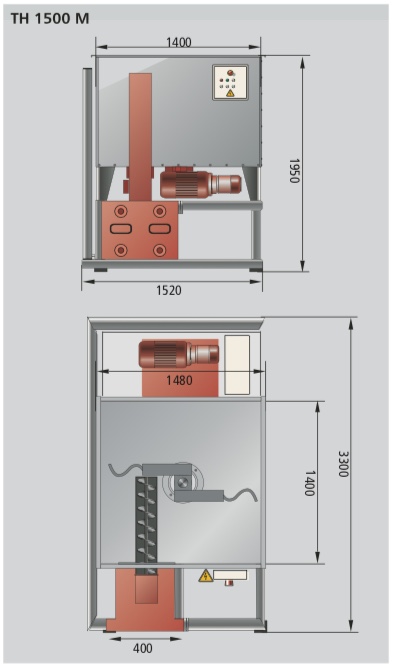
| Briquette Dimensions (mm) | 150 x 60 |
|---|---|
| Weight (approx. kg) | 3,500 |
| Hydraulic motor (kW) | 30 (40 hp) |
| Hydraulic motor for filling cylinder (kW) |
5.5 (7.5 hp) |
| Worm motor (kW) | 0.6 (.75 hp) |
| Permanent agitator (kW) | 2.2 kW (3 hp) |
| Oil quantity (ltr) | 500 |