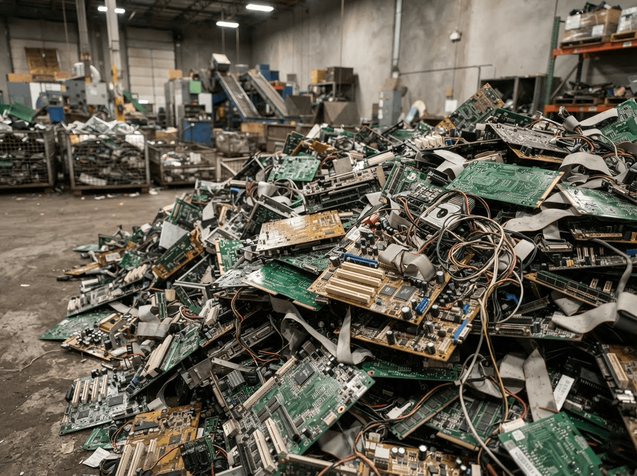
Most of the rare and critical metals used in batteries and electronics — lithium, cobalt, nickel, graphite, rare earth elements — come from a small number of foreign countries, with global refining concentrated in just a few of them. Recycling more of these materials domestically, instead of relying on new imports, is one of the most direct ways to reduce that dependence. Every battery, circuit board, or piece of electronic scrap recovered here is material the U.S. doesn't have to import.
That domestic recycling capacity comes from two different places: mining new ore, and recovering materials already in circulation. ERS works exclusively in the second one. ERS builds recycling equipment, not mining or ore-processing equipment — the raw material ERS handles has already been used once, in a battery, a circuit board, or industrial scrap, and the job is recovering the metal from it rather than extracting it from rock.
Before that recovered metal can be refined or reused, the raw scrap first has to be broken down and separated into a clean, workable feedstock. Shredded battery packs, mixed circuit boards, and complex electronic scrap all arrive as dense, mixed material, and getting from that raw state to something a refiner can actually use is a mechanical processing problem.
That's where ERS fits. ERS designs and builds the shearing, shredding, sorting, and separation equipment that turns raw recycled material into that feedstock — including black mass recovery systems that separate copper and aluminum out of shredded EV battery material, and electronics recycling systems that recover metals from circuit boards, cables, and mixed e-waste. Researchers and startups working on new ways to recover critical metals domestically often have the extraction chemistry solved before they have the equipment to process raw material at scale — and that mechanical front end is exactly what ERS provides.
Contact ERS to talk through what a recycling line built around your material stream could look like.