


Paper converting systems from the pickup at the machine to the bale on the dock
Paper converting systems from Engineered Recycling Systems take the trim, the scrap and the dust away from the machine and turn them into a baled product that leaves the building. ERS designs, builds, installs and services the complete system. One company, one system, one point of responsibility.
We build for every machine in the plant. Corrugators, flexo folder-gluers, rotary and flatbed die cutters, sheeters, slitters, rewinders and web presses. ERS captures trim, die cut scrap and fiber dust at the source, moves it without blockages, separates it, bales it, and cleans the air before it goes back into the building.
Most plants do not have a filter problem or a baler problem. They have a system problem: pickups that do not match the line they serve, a separator that has been added onto for fifteen years, and several suppliers who each stand behind their own box. Using different vendors leaves the plant owning the integration risk. ERS engineers the pickups, the duct, the fan, the separator, the baler and the filtration as one system, sized for one production rate and one static pressure, and stands behind the whole of it working.
How an ERS system works
Five stages, engineered against the same production rate and the same static pressure.
Capture
Machine pickups and floor sweeps collect trim and scrap at the source, sized to the width and the speed of the line rather than to a catalog number. Size reduction at the front of the system handles anything too bulky to convey cleanly, from a paper core shredder to an automated dump and run shredder. See paper converting industry trim removal.
Separate
A low profile separator splits the scrap from the dust-laden air. It is built for tight buildings: no roof penetrations, no airlocks, and it mounts directly over the baler. Where the building has the height to use, a cyclone separator does the same job.
Bale
Scrap drops straight from the separator into the baler and is compacted for recycling, with the baler sized to the volume the plant actually produces and the feed arranged so the operator is not working around it.
Filter
A CCM® OCT filter cleans the air and cleans its own media while the system keeps running, with no compressed air and no regeneration cycle. Where the dust is combustible, see combustible dust filtration.
Briquette
Collected dust is pressed into dense pucks on a briquette press and goes into the bale with the scrap. Dust leaves the building as a product instead of a disposal cost.
Indoors, safer and easier to service
The complete system installs indoors. No equipment on the roof, no external housings, no confined space entry, and service that does not wait on the weather.
Antistatic construction, internal grounding and non-combustible filter media come as part of the build, and the filter is laid out so a media change is a tool-free job on a walkway rather than a shutdown.
Industries we serve
The waste is different in each of them, but the requirement is the same: get it away from the machine immediately, move it reliably, and turn it into a product that leaves the building at the best price available.
Corrugated
Corrugators and box plants, where the trim is long, continuous and produced at speed. Capture at the machine, conveyed away before it can wrap a roll.
Explore →Tissue Converting
Tissue and towel lines, including TAD. Dust and trim taken off the machine without touching the web.
Explore →Folding Carton
Rotary and flat bed die cutters producing short scrap in bursts, with the hood and air volume sized for that pattern.
Explore →Paperboard
Heavier board and sheet operations, where the material load on the transfer line is what decides the design.
Explore →Commercial Printing
Web presses and sheeters, where a narrow fast ribbon has to leave the machine the moment it is made.
Explore →Direct Mail
High-speed mailing and finishing lines with mixed stock and frequent changeovers.
Explore →Flexible Packaging
Film and laminate trim, which behaves nothing like paper in a duct and is sized accordingly.
Explore →Paper Mills
Mill trim at volume, with the transfer line routed around a building that was not designed for it.
Explore →Slitting & Rewinding
Edge trim at the slitter and the rewinder, captured at the point it is created.
Explore →Light & Narrow Substrates
Where the substrate itself is the difficulty, light, narrow and fast, and a standard hood will not hold it.
Explore →Trim Removal & Dust Collection
The combined system: trim capture and filtration engineered together against the same static pressure.
Explore →Turnkey Waste Conveyance
The complete installed path from machine to baler, delivered and commissioned as one package.
Explore →Dust collection across the plant
Trim removal takes the scrap away. Dust collection keeps the air and the floor clean while the line runs. ERS engineers both as one airflow, not as two systems bolted together.
Industrial Dust Collection
Hoods, ducting, fan and filtration sized to the airflow your line actually needs, not to a catalog number.
Explore →Dust Collection for Converting
Built for converting floors, where fine paper dust comes off the web continuously and has to be captured at the source.
Explore →Paper, Tissue and Hygiene
For tissue, towel and hygiene product lines, where dust and fiber carry across the machine and settle on everything.
Explore →Rotary Die Cutters
Capture at the die cutter itself, so the dust leaves with the trim instead of settling into the next process.
Explore →Vacuum Transfer
Moves trim and dust through ducting under airflow, with no open handling and nothing dragged across the floor.
Explore →Cardboard Shredding
Reduces packaging and board waste to a consistent size, so it conveys cleanly and bales to a saleable density.
Explore →All Dust Collection Equipment
The separators, filters, fans and conveying equipment that make up a complete dust collection system.
Explore →Engineering, installation and service
ERS is an engineering company before it is a supplier. Every project starts with a plant survey, where we measure the machines, walk the intended routing and talk to the people who run the line about what actually goes wrong today.
From there we produce a system design, a layout drawing and a quotation that covers the complete installed system rather than a list of parts.
We install the system ourselves and commission it with the plant running, and we support it afterward with parts, service and system modifications as production changes. Converting plants add machines, move lines and increase speeds, and an ERS system is designed with the capacity and the access to grow with them.
Installed systems are written up as they go in, under project news and system updates.
The ERS Test Facility
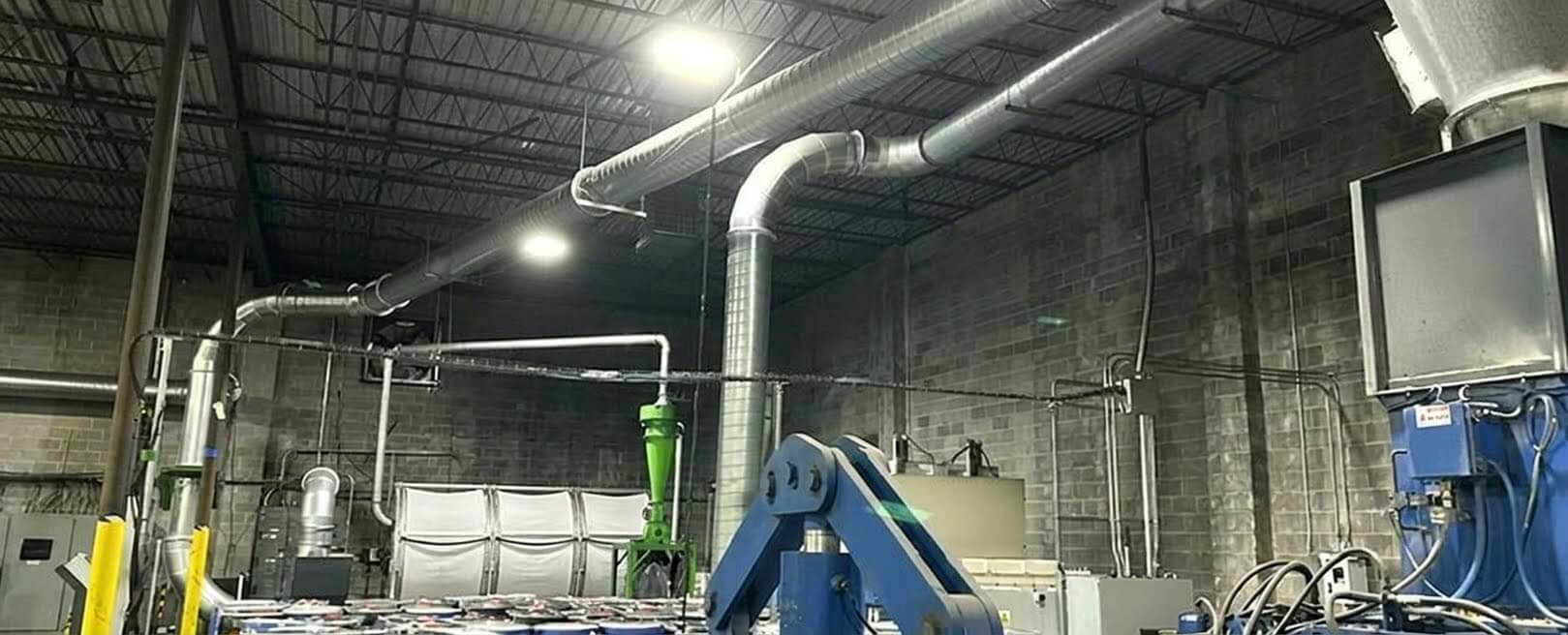
Material can be run at the ERS test facility in Atlanta where a question needs settling before anything is specified. Send a sample and we will show you what it does on a line.
Arrange a trialTalk to ERS about your plant
If trim is jamming your machines, if your transfer line plugs, if your baler cannot keep up, or if you are installing a new line and want the waste handling engineered properly from the start, ERS can help.
Call +1 770-954-8780, email info@engineeredrecycling.com or use the contact form, and we will arrange a plant survey.