


Capture It at the Machine Not on the Floor
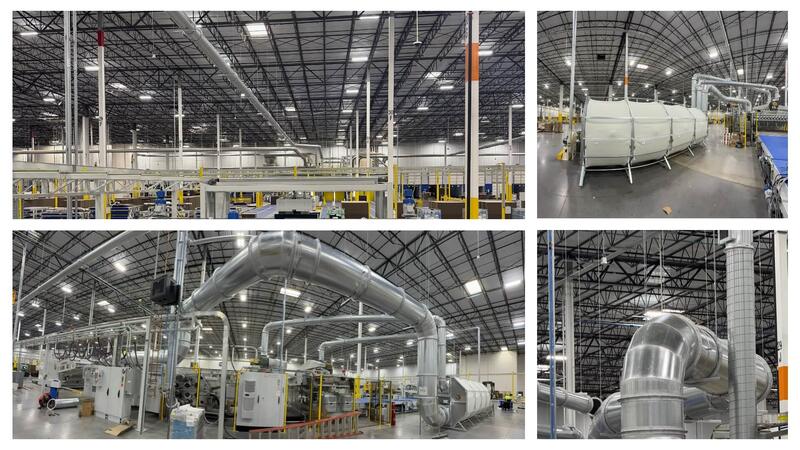
Dust collection systems for paper converting have to deal with three different problems at once: fiber shedding off the web, coating dust from printed and laminated stock, and static-driven particulate that will not settle anywhere useful. ERS engineers the capture, the conveying and the filtration as one system, sized for the machines and the building that exist rather than for a standard drawing.
Capture at Source
Dust that is caught at the machine never becomes a housekeeping problem. ERS places hoods and pick-up points at folding, laminating, printing, rewinding and packaging stations, and sizes the velocity for the stock actually being run. Lightweight tissue stock, coated papers and specialty substrates all behave differently in a duct, and a system designed for one of them will disappoint on the other two.
On die-cut work the heaviest single source is usually the press itself, which is covered in more detail under rotary die cutter dust collection.
Modular Airflow Control and Rotary Airlocks
ERS systems are built around modular airflow control, trim separation and rotary airlock technology. The airlock is what lets a collector discharge continuously without losing the pressure the rest of the system depends on. Modular airflow control means a plant that adds a line later is not forced to replace the system it already bought — the capacity is extended rather than scrapped.
Separation Before the Baler
Trim and scrap come out of the airstream before they reach the baling line. The Low Profile Separator does that in a fraction of the height a conventional cyclone needs, which is often what makes a retrofit possible at all in an existing converting hall. Where headroom allows, ERS builds conventional cyclone separators into the same position, and supplies and integrates the industrial balers downstream as part of the same installation.
Filtration and the CCM® OCT Filter
At the end of the system the air is filtered and returned to the building rather than exhausted, which in a heated plant is a running cost in its own right. The CCM® OCT filter cleans itself while the line keeps running. One gear motor sits outside the filter, out of the dust, and turns the central shaft and the boom. The nozzle traverse takes its motion from that rotation mechanically, so nothing electrical moves inside the drum and no compressed air or water is needed for cleaning. Scrapers turn with the shaft and wipe dust off the rings back onto the media.
Pressure drop stays low and airflow stays stable across a shift, and a media change is tool-free at roughly four to six minutes per panel.
The Air Side of a Transfer System
Where material is moved pneumatically, the air doing the moving has to be cleaned too. That is vacuum transfer air dust collection — the dust collection on the air coming off the transfer system — and it is sized for the whole plant running at once, not for a half-loaded line. Plants running several lines are better served by turnkey waste conveyance and dust collection systems that bring every station into one engineered waste stream.
Continuous Operation, Short Maintenance
ERS collectors are built to run continuously. Each system integrates with the converting machinery already installed, which keeps sheet surfaces clean, print quality consistent and throughput uninterrupted. Tool-free filter access and simple inspection keep the maintenance routine short. Systems are engineered to support compliance with NFPA, OSHA and local air quality requirements, worked through with the plant and its insurer site by site.
Scalable, and Built Around the Plant
Whether the job is a single converting line or a full production facility, the system is sized for the material flow, the machine layout and the production speed in front of us. The complete waste chain is described under trim removal and vacuum transfer air dust collection, and the wider equipment range sits on the paper converting systems page.
The same engineering serves corrugated box plants, folding carton converting, paperboard production, commercial printing, flexible packaging, label converting, tissue converting and paper mills, and the tissue and hygiene air side is covered under dust collection for paper, tissue and hygiene production.
Service and Spare Parts
A collector is worth what it does in year five. ERS keeps a stocked warehouse and supports every installation it builds, from commissioning through to spare parts and service. Filter media, wear parts and fan components are available without a lead time measured in months.
Next Steps for Your Paper Converting Dust Collection Project
If you are evaluating dust collection systems for paper converting or planning an upgrade to an existing line, send the details through the contact form. ERS will review the machine layout, the line speeds and the stock being run and come back with a system configuration that fits.