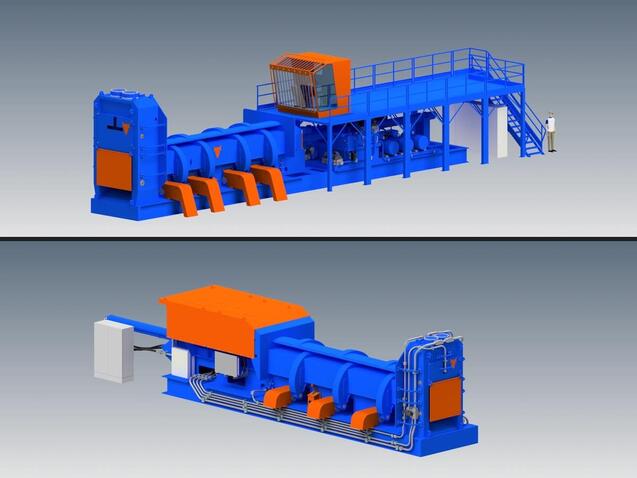
ERS builds and installs complete scrap processing lines across the United States and Canada, and the question we are asked more than any other is how to pick the scrap shear at the centre of one. So we are publishing a five-part series on how to choose a scrap shear.
Part 1 starts where most buying decisions do not: the manufacturer. True shear manufacturers are few. Does the supplier have the size, the machine tools and the structure to build one? Go and see where your money is going.
Requirements have moved. Only a few years ago a 300-ton machine with a 600 mm blade and a 5-metre box was standard. Today 500 tons is considered small, the blade is never shorter than 800 mm, and pre-compression boxes run 6 to 7 metres with an opening over 2.4 m — the width of a truck bed.
The reason is the material. Clean collected scrap and end-of-life vehicles increasingly go elsewhere, leaving the shear the tough, bulky, structural work. Quality of the sheared product now matters more than tonnage. A shear is expected to give at least 20,000 hours of honest service.
ERS partners with TAURUS in the U.S. for shear balers and mobile scrap processing equipment, and engineers the feed, separation and dust collection around them as one line.
Parts 2 to 5 follow weekly: design and construction, the shear, the pre-compression box, and the hydraulic and control system.