


How to Choose a Scrap Shear, Part 3: The Compression Box
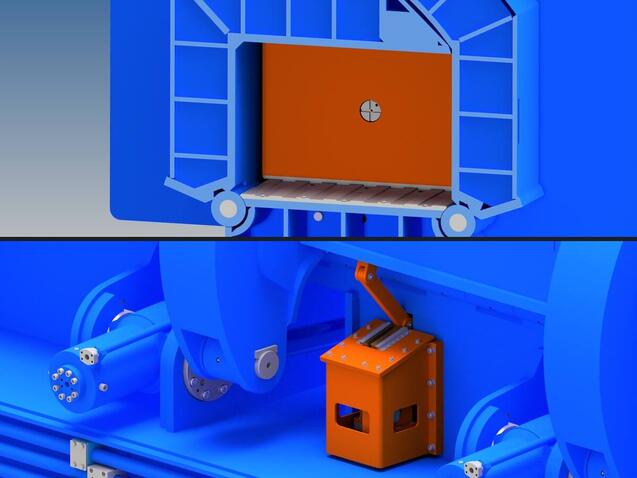
Part 3 of our series on how to choose a scrap shear covers the pre-compression box. It is the part that decides whether the cutting force you paid for ever reaches the scrap.
Match the box to the shear. There is no point in a 1,000-ton shear if the box cannot crush what that force is meant to cut. The cross-sections that work: 600 x 800 mm up to 600 tons, 600 x 900 mm from 600 to 800 tons, 700 x 1000 mm from 1,000 to 1,200 tons, 800 x 1100 mm from 1,200 to 1,500 tons.
Honeycomb, closed on the outside. Base and lids built as honeycomb and closed with a steel plate, preferably high-yield-strength steel, so eccentric and torsional loads spring back instead of deforming the box permanently.
Wear material at least 30 mm. Thinner than that where it touches the scrap and you are buying a consumable, not a structure. The sliding floor should be replaceable and corrugated lengthwise, so thin sheet does not pack at the rear and score the feed cylinder rod.
Overstroke on both lids, not one. Compressing below the box cross-section makes the scrap easier to push under the blade, and cuts both wear and feed cylinder vibration. One lid with overstroke is half the job.
Encoders outside the cylinders. A protected toggle-control encoder controls the overstroke and checks lid position, and avoids limit switches, proximity switches and linear sensors buried inside the cylinder — where they fail and are difficult to replace.
Cylinders under the box. Mounted underneath and guarded, they survive loading. Mounted outside, falling scrap finds them. And one base hinge should sit above the cylinder rods, so dust and corrosives do not settle on the chrome.
The one to walk away from: hinge and pivot seats welded onto a raw structure instead of machined after it is finished. Precise coupling is what gives hinges, pins and rods a long life, and it cannot be added later.
ERS partners with TAURUS in the U.S. for shear balers and inclined shears, and engineers the feed, separation and dust collection around them as one line.
Parts 4 and 5 follow weekly.