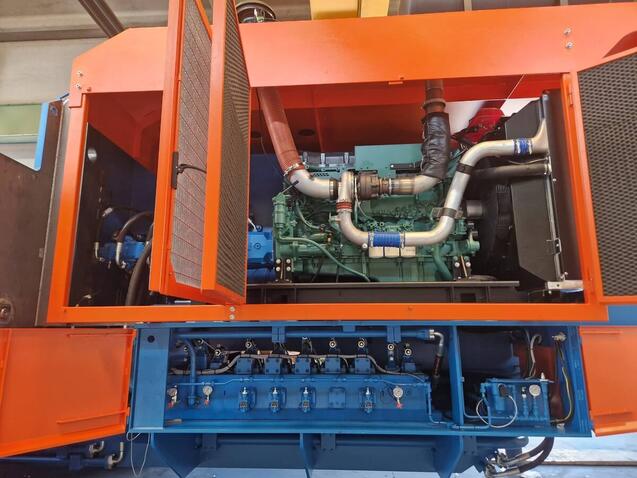
Part 4 of our series on how to choose a scrap shear goes inside the hydraulic system. It turns installed power into cutting force, and it decides how the shear behaves when the scrap gets tough.
Piston pumps for the main work. Constant-power piston pumps carry the load, and only the service pumps are anything else. With constant-power control the shear slows down and pushes harder as resistance rises, so it needs less installed power and less energy per ton cut.
Filtration at every stage. Air filters on the tank, pressure filtration on the pilot circuit, filtration on the return line and an independent filtration circuit. Filters cost far less than a pump.
A clean, accessible power unit. Few pipes, flexible hoses only where they are needed, and valves grouped on distribution panels that combine spool valves with 2-way cartridge elements. Easy to read and easy to service.
Higher working pressure. 240 bar (3,500 psi) was once considered extreme. Today 350 bar (5,100 psi) is the standard, and TAURUS runs at 420 bar (6,100 psi). Higher pressure means smaller oil volumes, a more compact system and lower building and maintenance costs.
ERS partners with TAURUS in the U.S. for shear balers and inclined shears, and engineers the feed, separation and dust collection around them as one line.
Read the previous part: Part 3, the compression box. Part 5, the electronics, follows next.