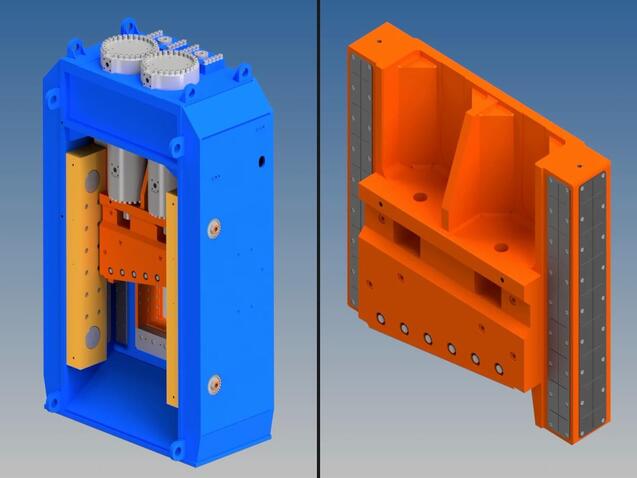
Part 2 of our series on how to choose a scrap shear goes inside the shear itself. It is the most punished part of the machine, and the part that decides what you spend on maintenance for the next twenty years. New, they all look up to the job. Time is the real judge.
Two cutting cylinders, not one. Twin cylinders balance the cutting system, cut contact friction and improve the piston guiding ratio for the same frame size. They also come out one at a time — a small cylinder is far easier to pull than a large one.
The guide ratio. Guide length to cutting width should be greater than 1.5. Below that, stress concentrates on the guides and the blade holder, and both wear out early. Six-sided prismatic guides, precision machined, spread the cutting forces into the structure and make adjustment simpler.
Synthetic on hardened steel. Dust particles embed in the plastic instead of seizing the guide, and the guides are self-lubricating. Steel on steel and bronze on steel are obsolete.
The blade angle. Reputable builders stay between 7° and 10°, with 9° to 10° the right compromise. Past 10°, the small gain in cutting capacity goes straight back out as friction and wear. Near 12°, material is driven against the shear wall and loads the blade holder off-centre.
The one to walk away from: welded guides, or no interchangeable wear plates on the surfaces that touch the scrap. Cheaper to buy, far more expensive to own.
ERS partners with TAURUS in the U.S. for shear balers and inclined shears, and engineers the feed, separation and dust collection around them as one line.
Parts 3 to 5 follow weekly.