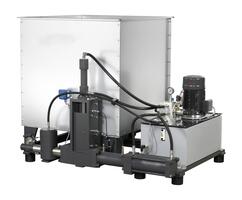
Briquette Press
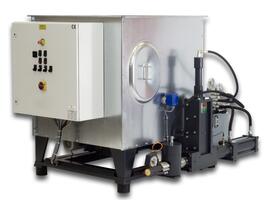
C 150 / C 170
Shaping your Waste with our Briquetting Solutions
A briquette press from Engineered Recycling Systems compacts loose chips, swarf, wood waste and collected dust into dense briquettes. The point is not the press on its own — it is what happens to material after it has been captured. ERS specifies briquetting as the discharge end of a complete trim removal and dust collection system, engineered and supported from Atlanta.
What a briquette press actually does
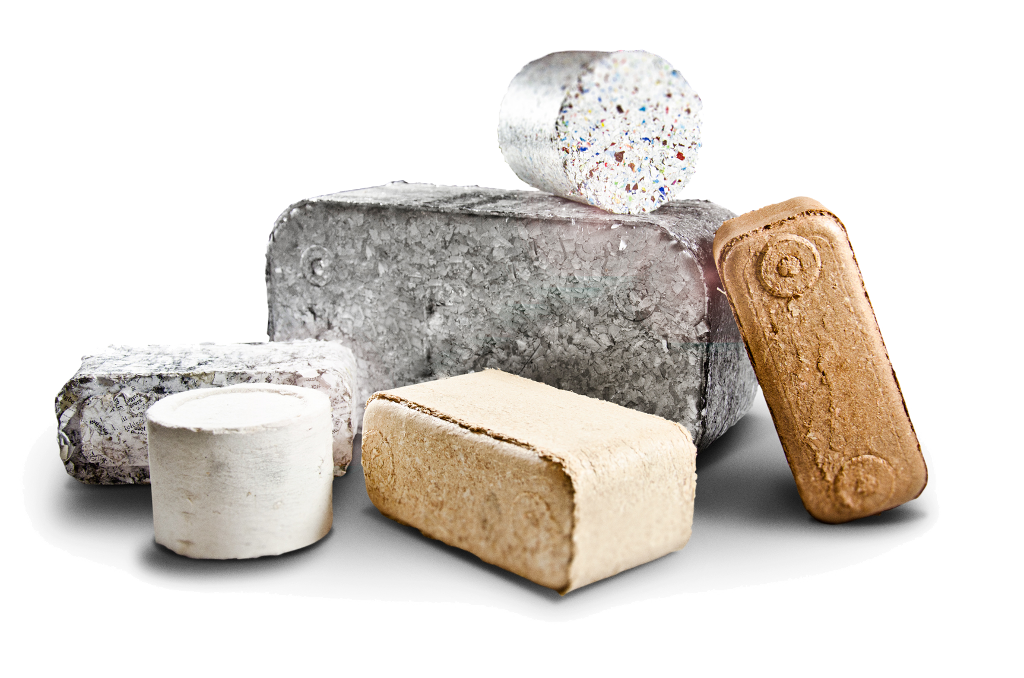
Loose material is fed into a die and compacted under high pressure until it holds its own shape. No binder is added. What comes out is a solid cylinder that can be stacked, stored, loaded and weighed like any other product, instead of a bulk volume that has to be blown, swept or shoveled.
The gain is mostly in handling. Loose chips and dust occupy a great deal of space for very little weight, so a plant ends up paying to move air. Briquetting reduces that volume substantially and takes the loose material out of open containers around the production floor.
Where the material comes from
In almost every installation the press sits downstream of something else ERS supplied. Fines and dust arrive through industrial dust collection and are dropped out of the airstream by a cyclone separator before they reach the press. On the filtration side, CCM® OCT filtration cleans its media continuously without compressed air, which keeps airflow steady enough for the discharge to be fed at a constant rate.
That matters more than it sounds. A press fed in surges produces inconsistent briquettes and spends time idling; a press fed evenly runs at a steady rate and needs far less attention.
Metal chips, swarf and coolant
On the metals side the material is usually turnings, chips and swarf wet with coolant. Compacting them squeezes a large share of that coolant back out, where it can be collected rather than carried away with the scrap. The briquettes that result are dry enough to handle and denser, which changes what a scrap buyer will pay for them.
Aluminum is the clearest case — see aluminum scrap and dust collection — but the same applies to steel turnings and mixed machining waste. Where upstream size reduction is needed first, ERS supplies shredders and mills and hammer mills as part of the same line.
Paper, corrugated and tissue dust
On the converting side the input is fine paper dust rather than metal. It comes off corrugated lines, paper converting operations, paper mills and tissue and hygiene production. Collected paper dust is light, it moves easily in air, and it is awkward to store loose.
Briquetting it turns a housekeeping problem into a stackable product. Where trim rather than dust is the bulk of the material, an industrial baler is usually the better answer, and ERS specifies whichever fits the stream — frequently both on the same site.
The sizes ERS supplies
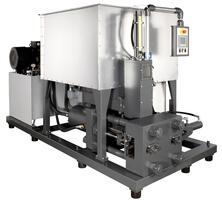
ERS integrates the WEIMA C and TH series, sized to the throughput of the line rather than to a catalog entry:
- C 150 and C 170e — the compact end, for lower volumes and tight installations
- TH-Series — the general-purpose range for most plants
- TH 800 M — higher throughput, continuous duty
- TH 1500 M — the largest, for heavy continuous production
Choosing between them is a question of how much material arrives per hour and how consistently, not of which machine has the highest headline figure. A press sized for a peak that happens twice a week spends the rest of its life running below its design point.
What the briquettes are worth
Briquettes are dry, compact and easy to store. Depending on the material they are sold on as secondary raw material, returned to a furnace, used as fuel, or simply disposed of at a far lower volume than the loose waste would have been. Several plants find that the recovered coolant alone accounts for a meaningful part of the case.
The less visible gain is floor space and labor. Material that used to sit in open bins waiting for a forklift becomes a predictable, countable output at one point in the plant.
How a project starts
With the material, not the machine. ERS wants to know what the stream is, how much of it arrives per hour, how wet it is and where it is currently going. Material can be run at the ERS test facility in Atlanta when a question needs settling rather than estimating.
From there the press is specified alongside the collection and conveying it depends on — the same approach used across metals processing equipment and paper converting systems. Every system ERS supplies is installed, commissioned and supported by ERS, with spare parts and service from Atlanta.
Talk to ERS about your material, your volumes and what it is costing you to handle loose.