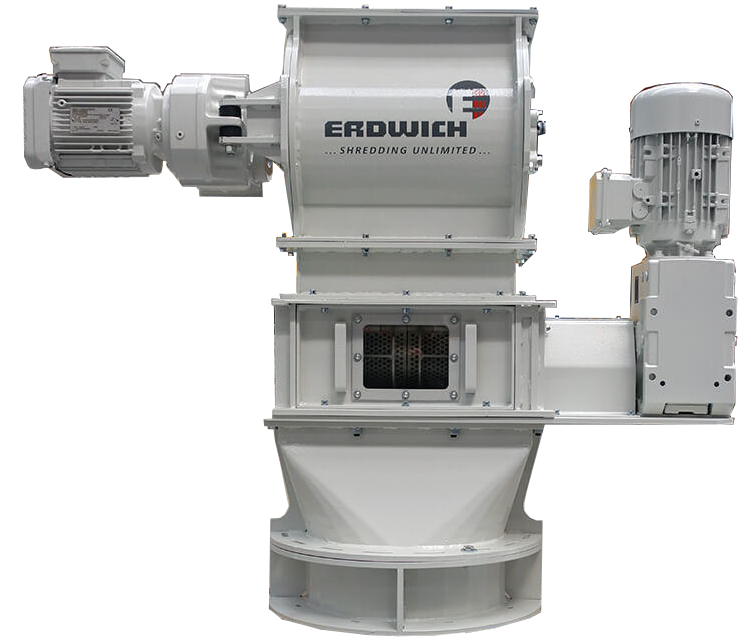
Single-Shaft Shredder
Single-shaft shredders reduce difficult, compressible scrap to one repeatable particle size in a single pass. Engineered Recycling Systems builds them into complete processing lines from Atlanta — not as a machine standing on its own, but as the primary reduction stage that everything downstream depends on.
How a single-shaft shredder works
Material is drawn onto the cutting rotor by a pneumatic ram and shredded repeatedly against a fixed stator blade. It stays in the cutting chamber until it is small enough to fall through the perforated screen below. The screen, not the rotor, sets the output size. That is why the fragment size coming out is predictable rather than approximate.
That predictability is the whole point. A consistent fragment is what makes magnetic separation, eddy current separation and density separation work properly downstream. An inconsistent one is what makes them fail, and the cost of that failure shows up as lost recovery at the far end of the line rather than at the shredder.
What ERS runs through them
Metal swarf and turnings from machining operations, which bird-nest and wrap on anything with a hammer. Punched components, offcuts and light structural drops. Aluminum scrap and zinc slag. Plastics, composite housings and cable trim. And secondary reduction of electronics recycling material, including stripped chassis, drive bodies and board fractions ahead of PCB recycling.
The common factor is material that resists a hammer mill. Springy, stringy or compressible scrap balls up under impact instead of breaking, and a machine that cuts rather than smashes is the answer.
Sizes and configuration
ERS supplies the M400, M600, M700 and M800. Each one is configured around your material rather than chosen off a size chart. Cutting geometry, rotor speed, screen aperture, drive power and feed arrangement are all selected for what you actually run and the tons per hour you need out of it.
The compact M400 is built for tight installations. Its screen-change construction opens from behind the machine, so there is no need for a transition funnel with a maintenance opening underneath it. Installation height drops, access improves, and changing a screen stops being a half-day job with a lift involved.
Built to keep running
Bulkhead seals protect the shaft bearings from fines, which is the failure mode that takes most shredders out of service and the one nobody budgets for. A PLC handles automatic reverse the moment the rotor loads up, and controlled power-down at the end of a shift. An integrated viewing window lets an operator watch the shredding process without opening anything, and the maintenance hatch is dust-tight.
Wear parts are the real running cost on any shredder. Rotor knives, stator blades and screens are consumables, and how quickly they can be swapped matters more over ten years than the purchase price did on day one.
What it costs to run
Throughput is set by three things: the screen aperture, the drive power and the material itself. A smaller screen gives a finer, more consistent fragment and lowers tons per hour. A larger one lifts throughput and passes more work to the separation stages behind it. There is no universally correct answer, only the right one for what you are recovering and what the downstream equipment needs to see.
Knife condition matters just as much. A sharp rotor cuts; a dull one tears and pushes, which raises amperage, heats the chamber and accelerates wear on everything else. Planned knife rotation is cheaper than unplanned downtime, and ERS builds a maintenance interval into the handover rather than leaving it to be discovered.
Where it sits in the line
A shredder on its own is not a solution. ERS engineers the single-shaft shredder together with conveyors, screens, magnetic separation, mills and dust collection so the whole line balances. A reduction stage that outruns the separation behind it does not increase throughput. It just moves the bottleneck somewhere harder to see.
Where throughput or feed size calls for a different machine, the Tritone industrial shredders and two-shaft shredders handle heavier and bulkier material, and hammer mills take over for final sizing. Choosing between them is part of the assessment. It is not a decision you need to have made before you pick up the phone.
Safety and dust
Shredding generates fines, and fines in the wrong place are both a housekeeping problem and, in some materials, a hazard. Aluminum, magnesium and certain plastics produce dust that has to be captured at the source and conveyed somewhere safe. ERS designs the capture, the ductwork and the filtration as one system with the shredder, because retrofitting dust control onto an installed line is always harder and more expensive than engineering it in at the start.
Screen access, and why it decides the install
On most single-shaft shredders the screen is changed from underneath, which means a transition funnel with a maintenance opening has to sit below the cutting chamber. That funnel sets the installation height, and on a retrofit into an existing building the height is often the thing that kills the layout.
A rear-access screen change removes it. The pickup point moves, the screen comes out from behind, and the machine sits lower. Access to the cutting chamber and the screen improves, there is no preparation work before a change, and the time the line stands still goes down. A viewing window lets the operator watch the shredding process, and the maintenance opening is built dust-tight so the gain in access does not cost housekeeping.
Where the feed has to be metered rather than dumped, the machine takes a rotary valve and a pneumatic feed system so material reaches the cutting chamber at a steady rate instead of in surges.
How a project starts
With your material, not with a quote. ERS looks at what you are processing, how much of it, what you need to recover from it, and the building it has to fit inside. Material can be run in the ERS test facility in Atlanta before anything is specified, so the configuration is based on your own scrap rather than on a data sheet from a brochure.
Every ERS single-shaft shredder is installed, commissioned and supported by ERS, with spare parts and service from Atlanta. The same people who engineered the line are the ones who come back to it. ERS also supplies TAURUS scrap processing equipment where the job calls for shears and balers alongside the shredding line.
Talk to ERS about what you are shredding and what you need out of it.
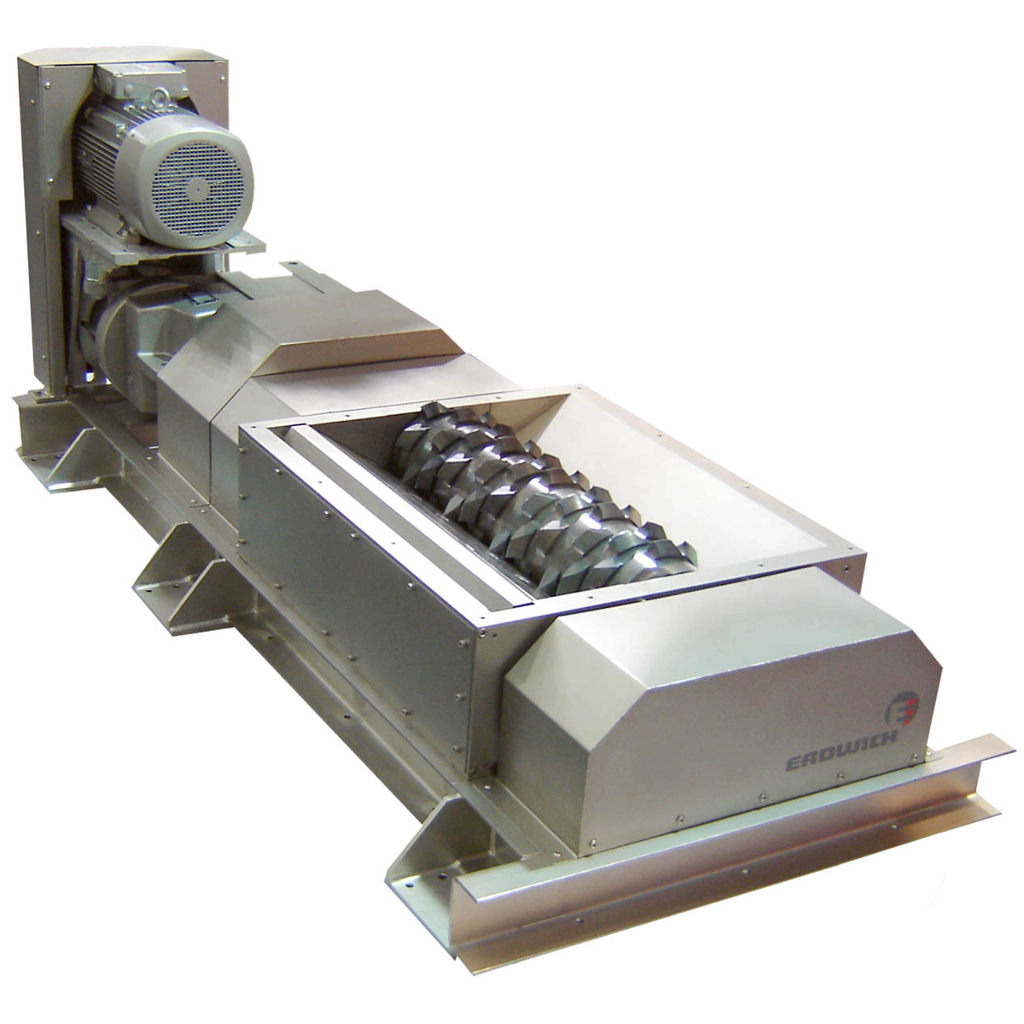
Compact Shredder M 400
For the first time modified compact version of the M 400 with new screen change construction leaves the Erdwich plant in Igling. New screen change construction developed: As a rule, the screen change takes place below the machine. In such cases, a transition funnel with maintenance opening sits underneath the cutting plant for a safe screen change. However, this method of construction is not feasible due to lack of space in this project. So rethinking was the order of the day. That's why our technicians have replaced the pickup point. Now the screen change can be made from behind.
The advantages are clear:
1) Lower installation height, since the standard transition funnel with maintenance opening is omitted
2) Better accessibility to the cutting plant or hole screen
3) Less preparation time during maintenance (no preliminary work required)
4) Less time spent on screen maintenance
5) Possibility of optical control of the shredding process by an integrated viewing window
6) dust-density design of the maintenance opening
The shredder is equipped with both a cell wheel lock and Equipped to a pneumatic impressionable system in order to be able to optimally supply the material to the cutting plant.