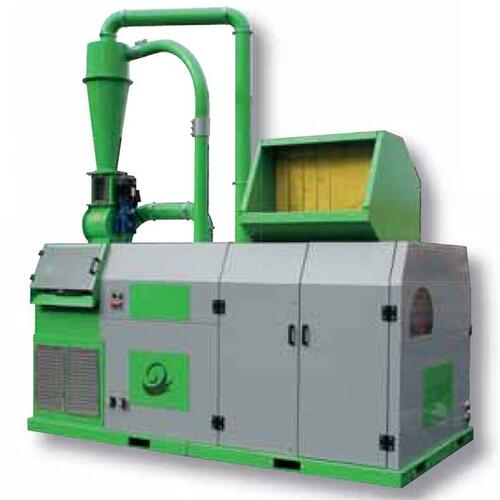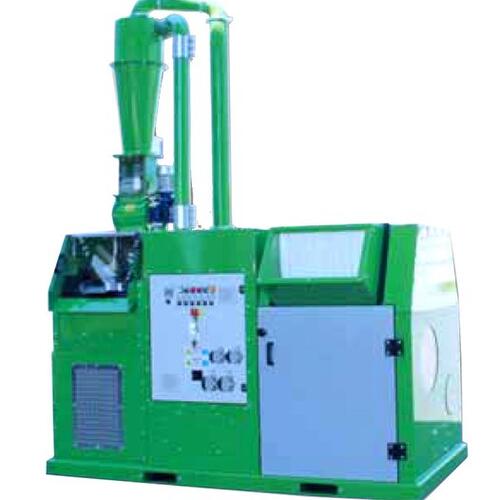
Related Equipment
Guidetti
Sincro
530
The Guidetti Sincro 415 is the compact granulator in the Sincro range, built to recover copper and aluminum from cable and radiators in a small footprint. It shreds and separates in one pass, dry, with no water and no chemicals, at up to 440 lb/h (200 kg/h). It is CE certified. Engineered Recycling Systems supplies, installs and supports it from Atlanta.
It suits a plant that has cable to process but not a hall to put a line in. Telecom cable, automotive harnesses, HVAC radiators and mixed flexible and rigid conductors all run through it without being sorted first.
Within the range it is the entry point for real production. Above it sit the Sincro 530 and the Sincro 950, and the Sincro Mill Line covers the same job in an even tighter footprint.
Four stages in one machine: a blade granulator, a zig-zag separator, a turbo mill and a dry densimetric table. Thick metal such as plugs and connectors comes out early in the cycle. Thin wire is reduced further so the separation stage has something it can actually split.
That sequence is the reason the output is clean rather than merely small. A granulator on its own gives mixed fragment; it is the mill and the table behind it that turn fragment into saleable copper.
The 415 separates metal from insulation — plastic, rubber or paper — and it also separates copper from aluminum, which matters on radiator work where the two arrive joined.
Anyone who has sold a mixed copper and aluminum fraction knows what the discount looks like. Splitting it on site is the difference between scrap and a graded product.
Purity is set by the feed as much as by the machine. Cable of one construction, fed steadily, gives a cleaner split than the same tonnage arriving as a mixed pile. That is worth knowing before a plant blames the granulator for a figure the infeed caused.
There is no water in the process and no chemical treatment. Nothing to permit, nothing to treat, nothing to dispose of. The separation is done on density by air and vibration.
The machine is soundproofed and has dust filtration built in, so it can sit inside a working building rather than in a shed at the back of the yard.
Manual or automatic by conveyor, whichever suits the building. Where the incoming cable is heavy, armored or bundled, a PMG pre-shredder goes in front so the granulator is fed material it can take at rate.
ERS also fits dosing conveyors, magnetic separation and dust extraction around it, so the line balances instead of one stage waiting on another.
Graded copper or aluminum, and a plastic fraction. Where the tailings still carry fine copper, a Reco Mill recovers it rather than letting it leave with the plastic.
On a machine this size that last stage is often what decides whether the numbers work, because the fines are where the margin hides.
The plastic fraction is worth a thought too. Clean, single-polymer insulation has a buyer; mixed insulation usually does not. Which of the two comes off the back depends on how the cable was sorted going in, not on the machine.
The mill is extractable, which is the single most useful thing about owning one of these. Blade changes stop being a strip-down. Sealed bearings, reinforced housings and a programmable PLC suit continuous duty with one operator.
Blades and screens are consumables, and what they really cost is the time the line stands still while they are changed. On a single-shift operation an extractable mill can be worth more over a year than a step up in rated capacity.
The 440 lb/h (200 kg/h) figure, like every figure on a granulator, depends on what is being fed. Fine telecom cable and heavy armored cable do not run at the same rate through the same blades, and the number that matters is the sustained one on the plant's own material.
With the cable. ERS looks at what arrives, how it is constructed, what purity the buyer wants and the space available. Material can be run at the ERS test facility in Atlanta before anything is specified, which on cable work settles arguments faster than any specification sheet.
Every machine ERS supplies is installed, commissioned and supported by ERS, with spare parts and service from Atlanta. The full Guidetti range and the wider copper wire and cable systems sit alongside it, within the ERS metals processing lineup.
Talk to ERS about what you are feeding and what purity you need to sell at.

Hit enter to search or ESC to close