


Sincro Mill Line Five Compact Cable Granulators, 265 to 1,980 lb/h
The Guidetti Sincro Mill Line is the compact end of the Guidetti cable granulation range: five machines that take rigid and flexible copper or aluminum cable together, without pre-selection, and separate metal from insulation dry. All five are CE certified. Engineered Recycling Systems supplies, installs and supports them from Atlanta.
The five models
The Sincro Mill 215 runs 175 to 265 lb/h (80 to 120 kg/h) on a 17 HP (12.5 kW) motor and weighs 2,140 lb (970 kg). The 315 gives 285 to 395 lb/h (130 to 180 kg/h) at 27 HP (20 kW). The 415 reaches 550 to 730 lb/h (250 to 330 kg/h) at 51 HP (38 kW). The 530 handles 990 to 1,320 lb/h (450 to 600 kg/h) at 71 HP (53 kW), and the 950 tops the line at 1,760 to 1,980 lb/h (800 to 900 kg/h) with 133 HP (99.5 kW) installed and a 12,130 lb (5,500 kg) frame.
Those are Guidetti's own ranges rather than single figures, which is the honest way to publish them. Where a plant lands inside a range depends on the cable, not on the machine.
The step between models is power and throughput rather than process. All five do the same job in the same sequence, so a plant can start small and move up the line later without relearning the machine.
Why no pre-selection matters
Most cable arriving at a yard is mixed: thin flexible conductor alongside rigid single-core, with connectors and plugs still attached. Sorting that by hand before granulation is the slowest and most expensive step in the whole operation.
The Sincro Mill Line takes it as it comes. Thick metals such as plugs and connectors are removed early in the cycle, and thin wire is reduced further so the separation stage has something it can actually split.
What is inside
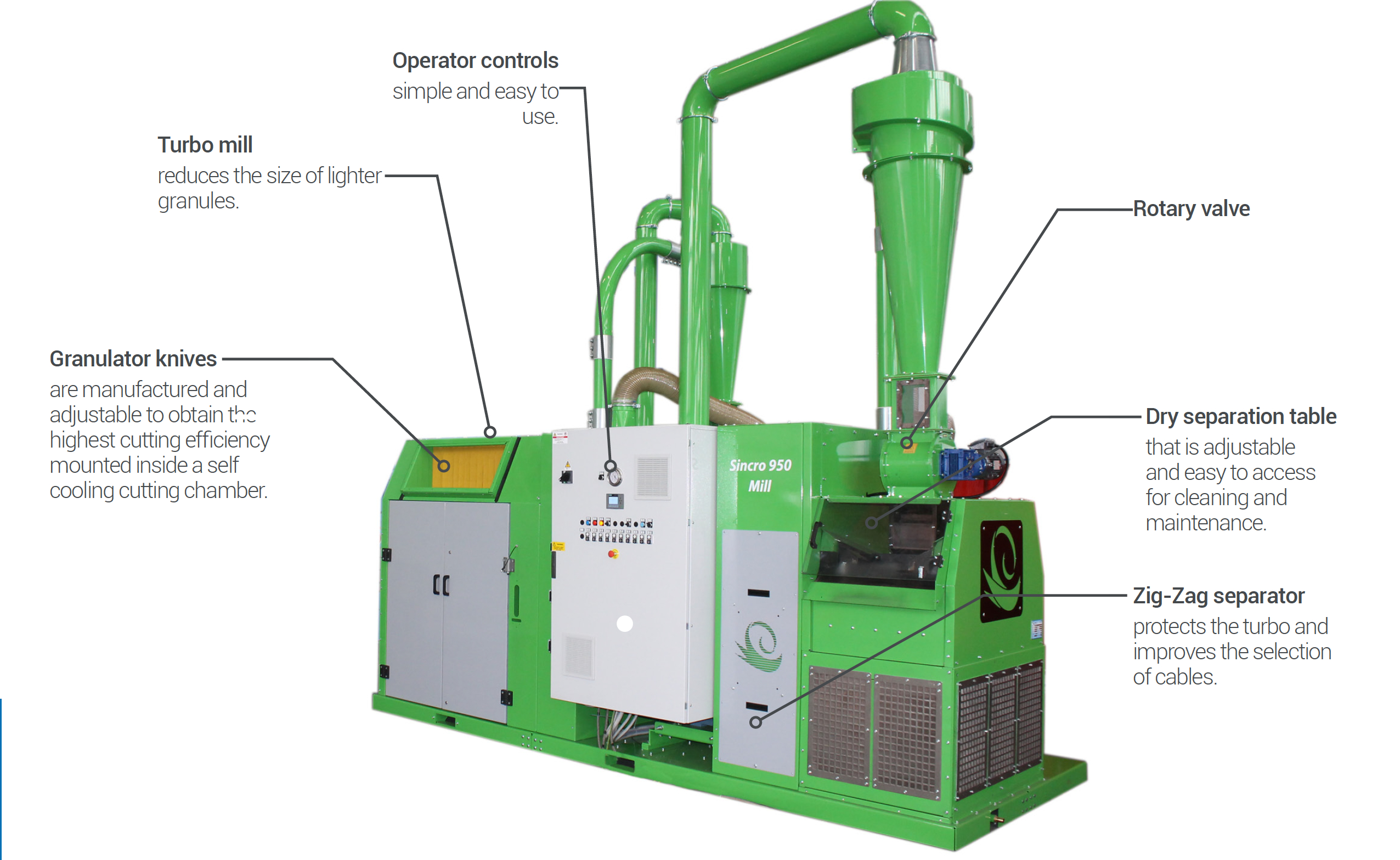
Four stages: a blade granulator, a zig-zag separator, a turbo mill and a dry densimetric table. The granulator reduces, the separator and mill do the sizing work, and the table makes the density split that produces a graded metal fraction rather than mixed fragment.
There is no water and no chemical treatment anywhere in that sequence. Nothing to permit, nothing to treat, nothing to dispose of.
Running one indoors
Soundproofed housing and integrated dust filtration are standard, which is what makes these machines practical in a building with people working around them rather than in a shed at the back of the yard.
On the smaller models the footprint is the point. A 215 fits where a line would not, which is often the difference between a plant processing its own cable and selling it on uncut.
What feeds it and what follows
Manual or automatic feeding, whichever suits the building. Where incoming cable is heavy, armored or bundled, a PMG pre-shredder goes in front so the granulator is fed material it can take at rate.
ERS fits dosing conveyors, magnetic separation, rotary valves and dust extraction around the machine so the stages balance. Behind it, a Reco Mill recovers fine copper from the tailings instead of letting it leave with the plastic.
Where it sits against the rest of the range
The Sincro Line covers the same work in larger single machines — the Sincro 415 at 440 lb/h (200 kg/h) through to the Sincro 950 at up to 1,980 lb/h (900 kg/h). The Wire Pro Series adds radiator and aluminum can work.
Which one a plant needs comes down to the material and the building, not to the headline rate. A smaller machine fed steadily will out-produce a larger one fed in surges, and it costs less to buy and to run.
Maintenance
Every unit has an extractable mill. That single feature is what turns a blade change from a strip-down into a short job, and on a single-shift operation it is worth more over a year than a step up in rated capacity.
Hinged panels, sealed bearings, reinforced housings and a programmable PLC suit continuous duty with one operator. Blades and screens are consumables, and what they really cost is the time the line stands still while they are changed.
What comes off the back
Graded copper or aluminum and a plastic fraction. The purity of both is set by the feed as much as by the machine — cable of one construction, fed steadily, gives a cleaner split than the same tonnage arriving as a mixed pile.
Clean single-polymer insulation has a buyer; mixed insulation usually does not. Which of the two comes off the back depends on how the cable was sorted going in.
How a project starts
With the cable. ERS looks at what arrives, how it is constructed, what purity the buyer wants and the space available. Material can be run at the ERS test facility in Atlanta before anything is specified, which on cable work settles arguments faster than any specification sheet.
Every machine ERS supplies is installed, commissioned and supported by ERS, with spare parts and service from Atlanta. The full Guidetti range and the wider copper wire and cable systems sit alongside it, within the ERS metals processing lineup.
Talk to ERS about what you are feeding and what purity you need to sell at.


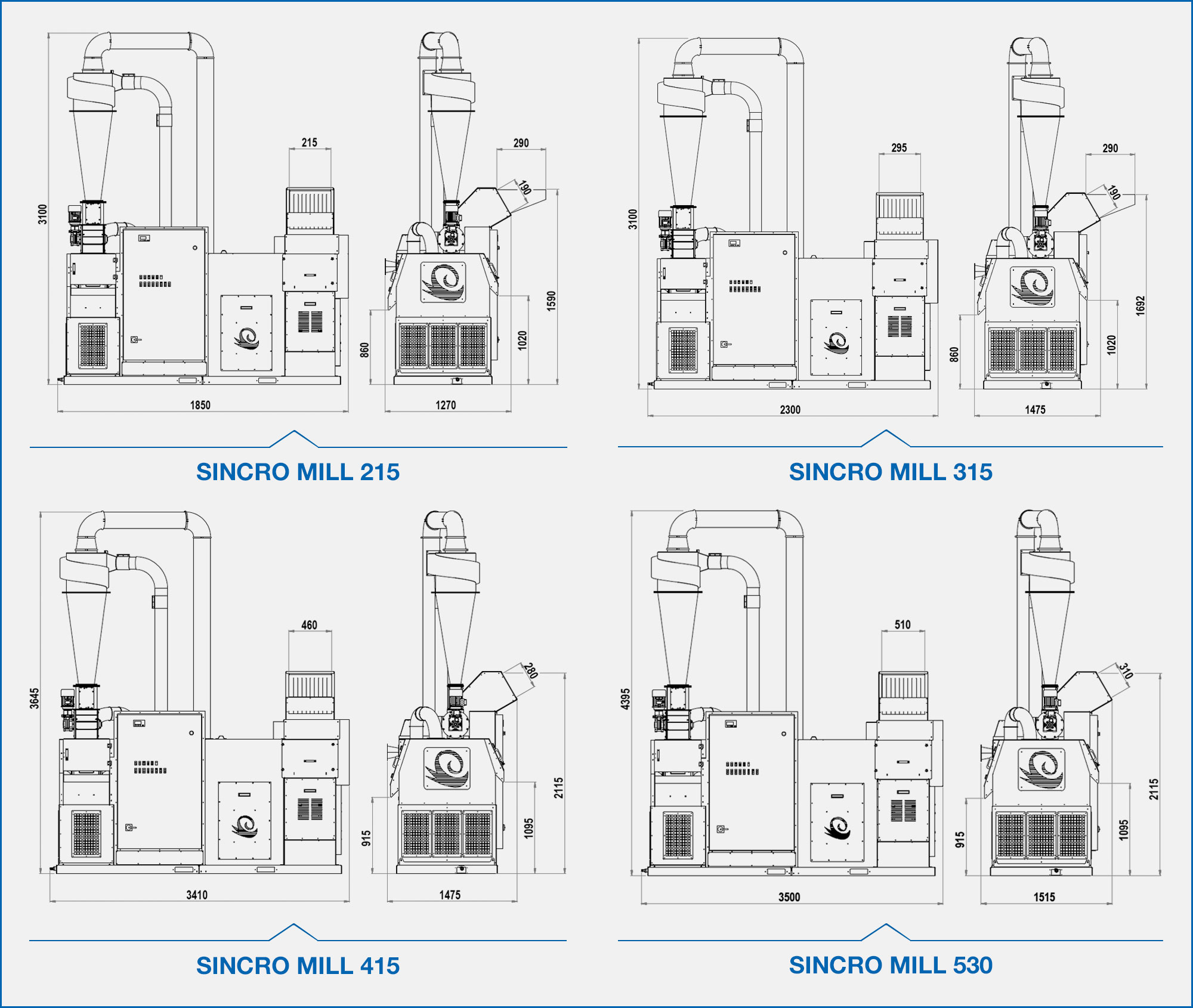
Guidetti 215 Sincro Mill

Guidetti 315 Sincro Mill

Guidetti 415 Sincro Mill

Guidetti 530 Sincro Mill

Guidetti 950 Sincro Mill

| Technical Data |
Length | Width | Height | Weight | Power | Production |
|---|---|---|---|---|---|---|
| SINCRO MILL 950 |
4516 mm 177.8'' |
4403 mm 173.0'' |
5500 kg 12,125 lb |
99.5 kw 133.5 HP |
1000-1200 kg/h 2200-2645 lb/h |
|
| SINCRO MILL 215 |
2300 mm 90.6'' |
1458 mm 57.4'' |
3084 mm 121.4'' |
970 kg 2138 lb |
12.5 kw 16.8 HP |
80-120 kg/h 176-264 lb/h |
| SINCRO MILL 315 |
2316 mm 91.2'' |
1475 mm 58.1'' |
3100 mm 122.0'' |
1200 kg 2646 lb |
20.0 kw 26.8 HP |
130-180 kg/h 286-396 lb/h |
| SINCRO MILL 415 |
3410 mm 134.3'' |
1472 mm 58.0'' |
3637 mm 143.2'' |
2500 kg 5512 lb |
38.0 kw 50.9 HP |
250-330 kg/h 551-727 lb/h |
| SINCRO MILL 530 |
3410 mm 134.3'' |
1515 mm 59.6'' |
4395 mm 173.0'' |
2700 kg 5952 lb |
53.0 kw 71.0 HP |
450-600 kg/h 992-1322 lb/h |