


Reco Mill Line Recovering the Copper Your Granulator Misses
The Guidetti Reco Mill Line recovers copper from the plastic tailings left behind by cable granulation. It is the stage most plants do not have, and it works on material they are currently paying to dispose of. Three models, all CE certified. Engineered Recycling Systems supplies, installs and supports them from Atlanta.
What the Reco Mill actually does
Granulation never separates perfectly. A fraction of the copper leaves with the plastic as dust and fine particles, too small for the main densimetric table to catch. On a line running all day that fraction adds up to a real sum.
The Reco Mill reprocesses those tailings through a zig-zag separator, a turbo pulverizer and a dry separation table, pulling the fine copper back out. What was waste becomes a saleable fraction, and the plastic that leaves is cleaner than the plastic that went in.
The three models
The Reco Mill 15 runs 265 to 440 lb/h (120 to 200 kg/h) on 17 HP (12.5 kW) in a footprint of 97 × 50 × 122 inches (2461 × 1260 × 3100 mm). The Reco Mill 50 handles 880 to 1,320 lb/h (400 to 600 kg/h) at 54 HP (40 kW). The Reco Mill 100 reaches 1,760 to 1,980 lb/h (800 to 900 kg/h) on an 8,380 lb (3,800 kg) frame with dry separation integrated.
Which one a plant needs follows from how much tailings the granulation stage produces, not from the granulator's rated capacity. The two are related but they are not the same number, and getting it wrong means either a machine standing idle or a pile that never clears.
Where it sits in a line
Behind the granulator, as a post-processing stage. It takes the output a Sincro Line, Sincro Eko Line or Sincro Mill Line would otherwise send to waste.
It is not limited to Guidetti machines. A Reco Mill can be added behind a third-party granulator just as easily, which is often how a plant justifies one — the recovery pays for itself without replacing anything upstream.
The case for adding one
Two things improve at once. Recovery goes up, because copper that was leaving the building now gets sold. Disposal cost goes down, because the plastic fraction is cleaner and lighter.
How quickly that pays back depends on the copper price, the volume of tailings and what disposal currently costs. Those are the three numbers to put on paper before specifying a machine, and ERS will work through them rather than quote a generic payback period.
Dry, quiet and filtered
No water and no chemical treatment. The separation is done on density by air and vibration, so there is nothing to permit, nothing to treat and nothing to dispose of.
Soundproofed enclosures and integrated dust filtration come as standard, which matters more here than on a granulator. Tailings are fine material, and handling fine material badly is how a plant ends up with a dust problem it did not have before.
Build and controls
A programmable PLC, sealed bearings and reinforced housings suit continuous duty with minimal supervision. Hinged panels and intuitive controls make inspection and maintenance straightforward.
The machines are compact by design. A Reco Mill usually has to go into a plant that was laid out without one, which means the footprint is as much a part of the specification as the throughput.
Options and integration
Dosing conveyors and magnetic separation can be specified alongside, and ERS fits the machine with conveyors and dust extraction so it sits inside the existing material flow rather than beside it.
The commonest mistake is treating the Reco Mill as a standalone addition. It only earns its keep when the tailings reach it continuously, which is a handling question before it is a machine question.
What comes out
A recovered copper fraction and a cleaner plastic stream. The purity of both depends on what the granulation stage produced, so a Reco Mill improves a good line considerably and a poorly fed one only a little.
That is the honest way to put it. The recovery is real, but it is recovery from what the stage in front of it let through.
How a project starts
With a sample of the actual tailings. ERS looks at what the current line is losing, in what volume, and what the plastic fraction costs to dispose of now. Material can be run at the ERS test facility in Atlanta, which on this stage is the only way to get a credible recovery figure.
Every machine ERS supplies is installed, commissioned and supported by ERS, with spare parts and service from Atlanta. The full Guidetti range and the wider copper wire and cable systems sit alongside it, within the ERS metals processing lineup.
Talk to ERS about what your line is currently throwing away.


Guidetti Reco Mill 15

Guidetti Reco Mill 50

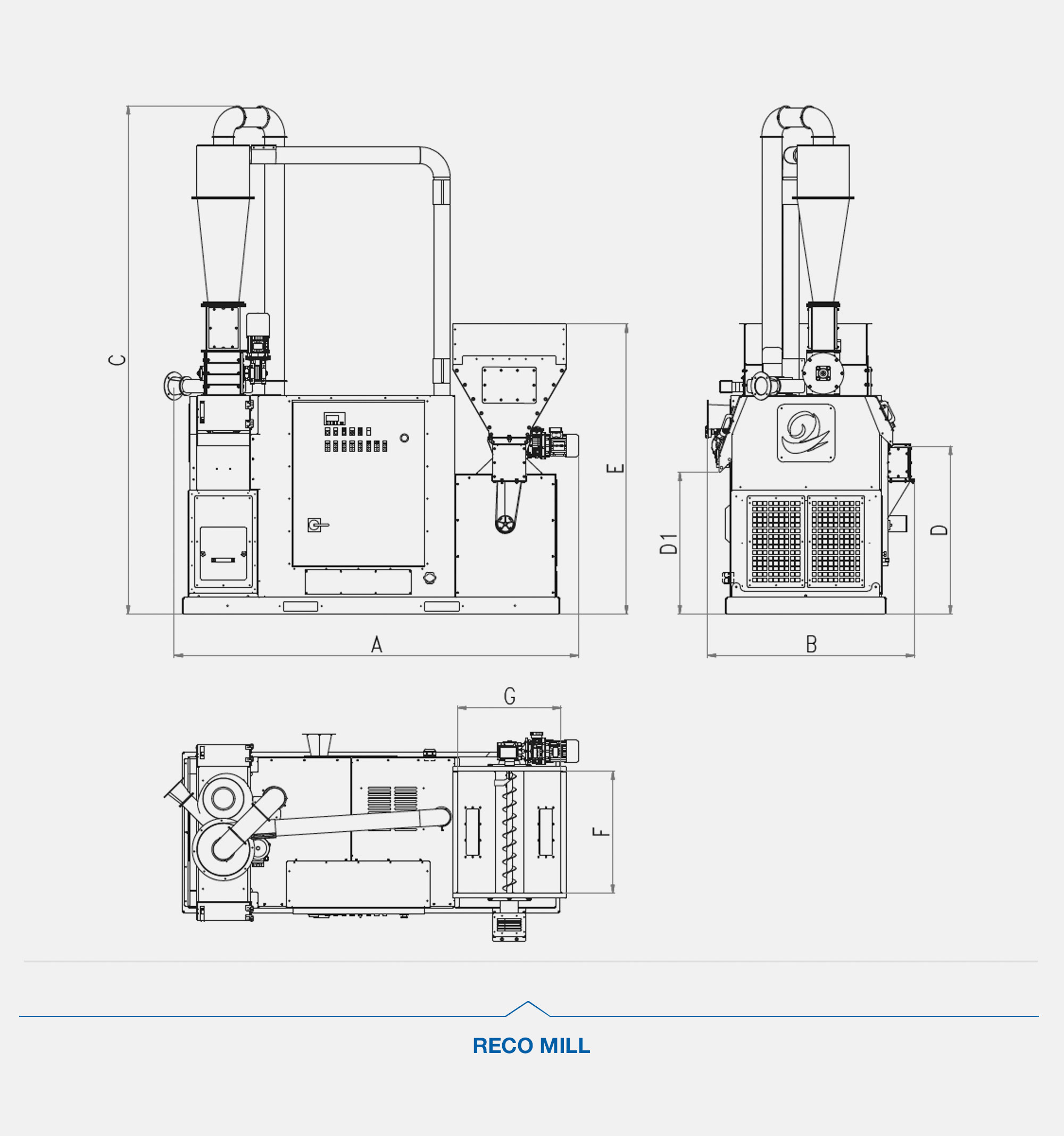
| Technical Data |
Length | Width | Height | Weight | Power | Production |
|---|---|---|---|---|---|---|
| Reco Mill 50 |
3453 mm 135.9'' |
1450 mm 57.1'' |
4386 mm 172.7'' |
2220 kg 4894 lb |
40.0 kw 53.6 HP |
400-600 kg/h |
| Reco Mill 15 |
2461 mm 96.9'' |
1260 mm 49.6'' |
3100 mm 122.0'' |
990 kg 2183 lb |
12.5 kw 16.8 HP |
120-200 kg/h |