


Dry Separation Tables for Copper, Aluminum, Plastics and Wood
Guidetti dry separation tables sort granulated material that is the same size but a different density. That is the problem no screen can solve: once copper and PVC have been granulated to the same fragment, only density tells them apart. Engineered Recycling Systems supplies and integrates the range from Atlanta.
How a dry table works
A perforated deck vibrates while air is blown up through it. The lighter fraction floats on the air cushion and travels one way; the heavier fraction keeps contact with the deck and is walked the other way by the vibration. Adjust airflow, vibration and feed rate and the split point moves.
No water, no chemicals, no drying stage afterwards and no effluent to handle. For most plants that is the deciding factor rather than the separation performance itself.
The range
The ROBI series covers general duty. The Robi 71 is the compact table at 76 x 57 x 80 inches (1930 x 1455 x 2030 mm), 1,830 lb (830 kg) and 4.7 HP (3.5 kW). The Robi 151 steps up to 85 x 73 x 94 inches (2170 x 1860 x 2395 mm), 2,360 lb (1,070 kg) and 6.7 HP (5 kW) installed power.
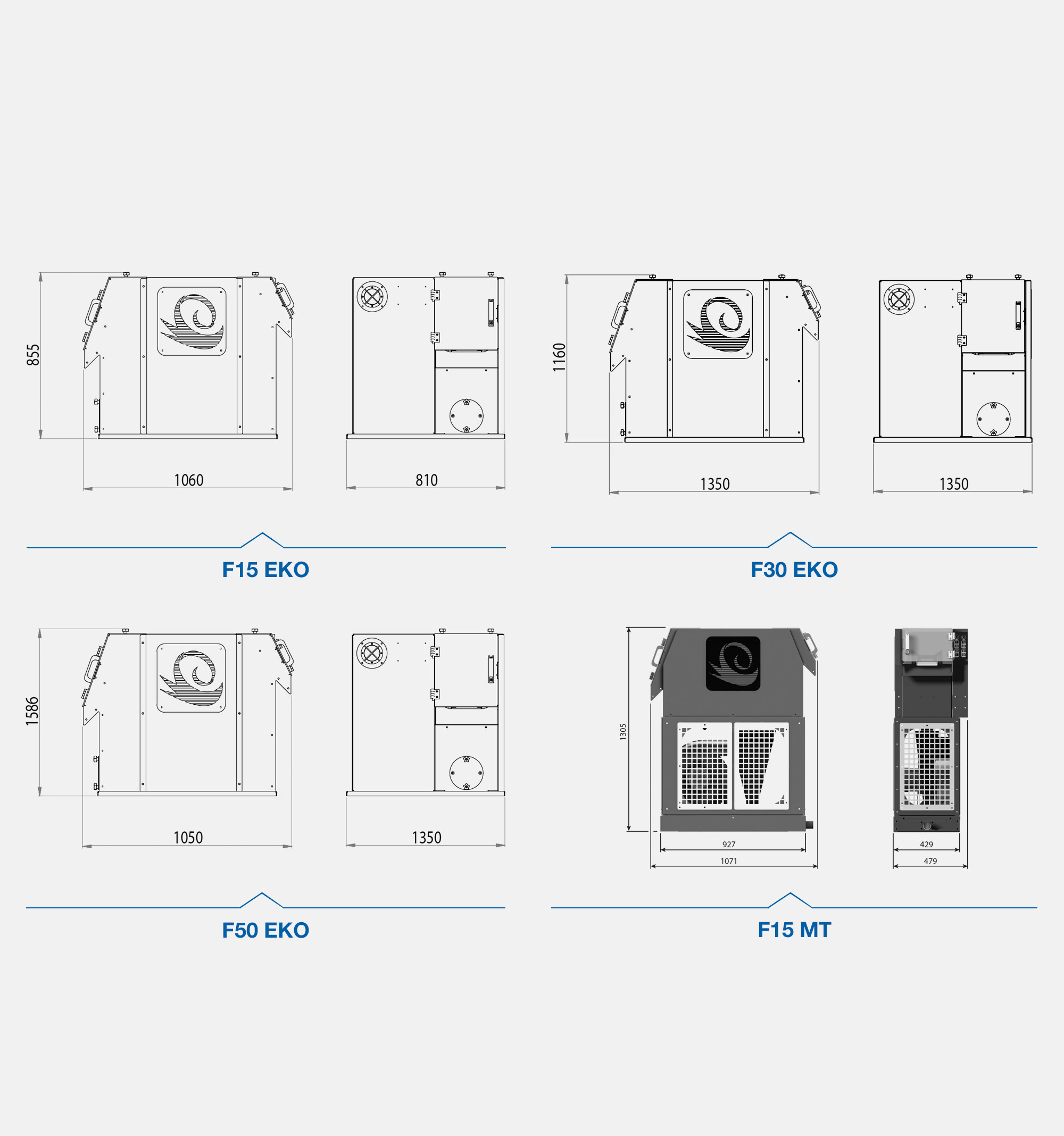
The F-Series — F15 Eko, F30 Eko, F50 Eko and F15 MT — is matched to specific material streams and tighter layouts. The F15 MT weighs just 254 lb (115 kg), which makes it practical for small-scale or precision separation where a full table would be over-specified.
What it separates
Copper from aluminum. Metals from PVC and rubber. Plastics from sand and stone. Light fractions from glass and metal fragments. In insulated copper wire and cable work it is the stage that lifts the product from a mixed granulate to a saleable copper grade.
It also recovers what earlier stages missed. Telecom cable, automotive harness, composite scrap and mixed granules all leave residue that air separation alone will not split, which is where the Reco Mill line and a density table together recover material most plants send to landfill.
Where it sits in the line
After granulation, never before it. A PMG pre-shredder opens the feed, a Sincro granulation line liberates the metal from the insulation, magnetic separation pulls the ferrous fraction, and the table does the final density split.
Each stage depends on the one before. A table fed an inconsistent fragment will drift no matter how carefully it is set, which is why the granulator specification matters as much here as the table does.
Material moves between stages on conveyors or through pneumatic transport, and the fines come off into dust collection rather than into the building.
Running one in practice
Airflow, vibration and feed rate are adjustable in real time, and they need to be — a change of material changes the setting. Operators who understand the three controls recover materially more than those who set it once and leave it.
The tables are soundproofed, with sealed bearings and reinforced housings, and carry CE certification. Energy consumption per ton is low, which on a stage that runs continuously is a real operating cost rather than a specification line.
How a project starts
With a sample. How cleanly a material separates by density is genuinely hard to predict from a description, and the split is what decides the grade you sell. Material can be run at the ERS test facility in Atlanta before anything is committed.
Every table ERS supplies is installed, commissioned and supported by ERS, with spare parts and service from Atlanta. Where a plant also needs shears or balers, ERS supplies TAURUS scrap processing equipment alongside.
Talk to ERS about the fraction you are trying to split and the grade you need out of it.


Robi 71

Robi 151

F15 Separator

F30 Separator

F50 Separator

F15-MT Separator

| Technical Data |
Length | Width | Height | Weight | Power | Production |
|---|---|---|---|---|---|---|
| F15 MT |
1071 mm 42.2'' |
479 mm 18.9'' |
1305 mm 51.4'' |
115 kg 254 lb |
(*) changeable according to the material processed kg/h |
|
| Robi 71 | 1930 mm 57.3'' |
1455 mm 57.2'' |
2030 mm 79.9'' |
830 kg 1830 lb |
3.5 kw 4.7 HP |
(*) changeable according to the material processed kg/h |
| Robi 151 | 2170 mm mm 85.4'' |
1860 mm 73.2'' |
2395 mm 94.3'' |
1070 kg 2359 lb |
5.0 kw 6.7 HP |
(*) changeable according to the material processed kg/h |
| F15 Eko |
1060 mm 41.7'' |
810 mm 31.9'' |
855 mm 33.7'' |
192 kg 423 lb |
0.76 kw 1.0 HP |
(*) changeable according to the material processed kg/h |
| F30 Eko |
1350 mm 53.1'' |
1350 mm 53.1'' |
1160 mm 45.7'' |
535 kg 1179 lb |
1.8 kw 2.4 HP |
(*) changeable according to the material processed kg/h |
| F50 Eko |
1050 mm 41.3'' |
1350 mm 53.1'' |
1586 mm 62.4'' |
390 kg 860 lb |
2.0 kw 2.7 HP |
(*) changeable according to the material processed kg/h |